Seven Ways AI Changes What Marketing Automation Is
AI is not a feature of the next marketing automation platform. It changes what a marketing automation platform is.
1. The Promise
Don Peppers and Martha Rogers published The One-to-One Future in 1993. I graduated college the next year, went to work in marketing tech, and have been chasing the idea in that book ever since.
Their argument started with the old-fashioned corner store. The 1800s grocer knew Mrs. Smith bought Earl Grey and set some aside when a shipment came in, and he heard the Johnsons were having people over and had most of the order together before anyone asked for it. He wasn't running a loyalty program. He knew a few hundred people and he paid attention.
Then the industrial era arrived and traded that relationship for choice and lower prices. Stores got bigger, stopped knowing anyone in particular, and marketing became the business of talking to everybody at once and hoping some of it applied to somebody. Peppers and Rogers saw the deal we'd made and proposed a better one: give us corner-store relationships at industrial-era scale.
Thirty-three years later, the idea still captures my imagination and my hopes for what marketing can and should be. Marketers get a bad rap as the people who clutter your inbox, and often we've earned it. But the work is worth doing. Somewhere out there is a person whose quarter gets easier because of something you sent them, and who would never have found it on their own. That happens when the message reaches the right person at a moment when it helps, which is exactly what marketing has never been able to do reliably. Get it right and marketing stops being something people put up with. It becomes relevant, useful, and perhaps even loved.
2. Four Attempts
I have spent my career chasing the dream, working at companies that promised some version of this. Epiphany, Marketo, Engagio, Demandbase. Every one of them sold personalization. None of them got all the way there.
Epiphany got close. Our Interaction Advisor product could arbitrate across dozens of offers and pick the best one in real time. The use cases were mostly B2C, and the machine learning was primitive by current standards, but it worked, and it showed me what it looked like when software chose rather than followed.
At Marketo, personalization meant segmentation, tokens, and dynamic content. You could put someone's first name in a subject line and swap a paragraph based on their industry. Underneath, everyone in the same track got the same core emails in the same order.
Engagio and Demandbase came at it from the account-based marketing side. ABM can produce genuine one-to-one, and I've seen teams do beautiful work, but it comes from manual effort. That works for the tier one list you can count on two hands. It does not work for the other four thousand accounts, and every ABM program I've seen eventually runs into that wall.
Demandbase and Marketo also have web personalization capabilities, but what most customers actually do with them is change the banner based on someone's industry, show a different message to customers than to prospects, or perhaps recommend popular content.
Across four companies, I've been chasing this for almost thirty years, and I've never been able to fulfill the dream. The closest anyone got was Epiphany, and even that one could only choose a single offer for a person in real time, which is a long way from planning six months of touches for a complex buying committee.
3. Why Nothing Changed
So why didn't the legacy platforms ever get there?
Part of it is commercial. Marketo went to Adobe, Eloqua to Oracle, Pardot to Salesforce. Inside companies that size, a marketing automation platform becomes one line in a larger suite, and it stops being the thing anybody invests in.
The deeper reason is architectural. These platforms were built for the old playbook and haven't kept up with the changes in the market — not because they didn't want to, but because they couldn't. They're held back by legacy architecture and the fundamental way they were built to work.
Trust me, I should know — I was instrumental in building them.
4. Then AI Arrived
Then AI arrived, and it has changed nearly everything about how companies sell and how people buy. But it has not changed the software most B2B marketing teams use (yet).
Modern reasoning models can decide. They don't need every possibility written down in advance. They work out the right thing at the moment the decision comes up, weighing one consideration against another the way a person does.
They can also take direction. You describe what you want in plain language and the system builds it, following the standards and the constraints you've given it. Intent no longer has to be translated into configuration by someone who knows where every setting lives.
AI is not a feature of the next marketing automation platform. It changes what a marketing automation platform is. Gartner puts the shift in a single line: "Agentic AI changes the unit of work from task to decision."
You don't get there by bolting AI onto a platform designed twenty years ago. Gartner found that 45% of martech leaders running AI agents in pilots or production say the vendor-supplied agents don't meet their expectations for business performance. Some of that is data and governance readiness. Some of it is simpler: an AI layer on an architecture built to follow rules mostly makes the rules run faster.
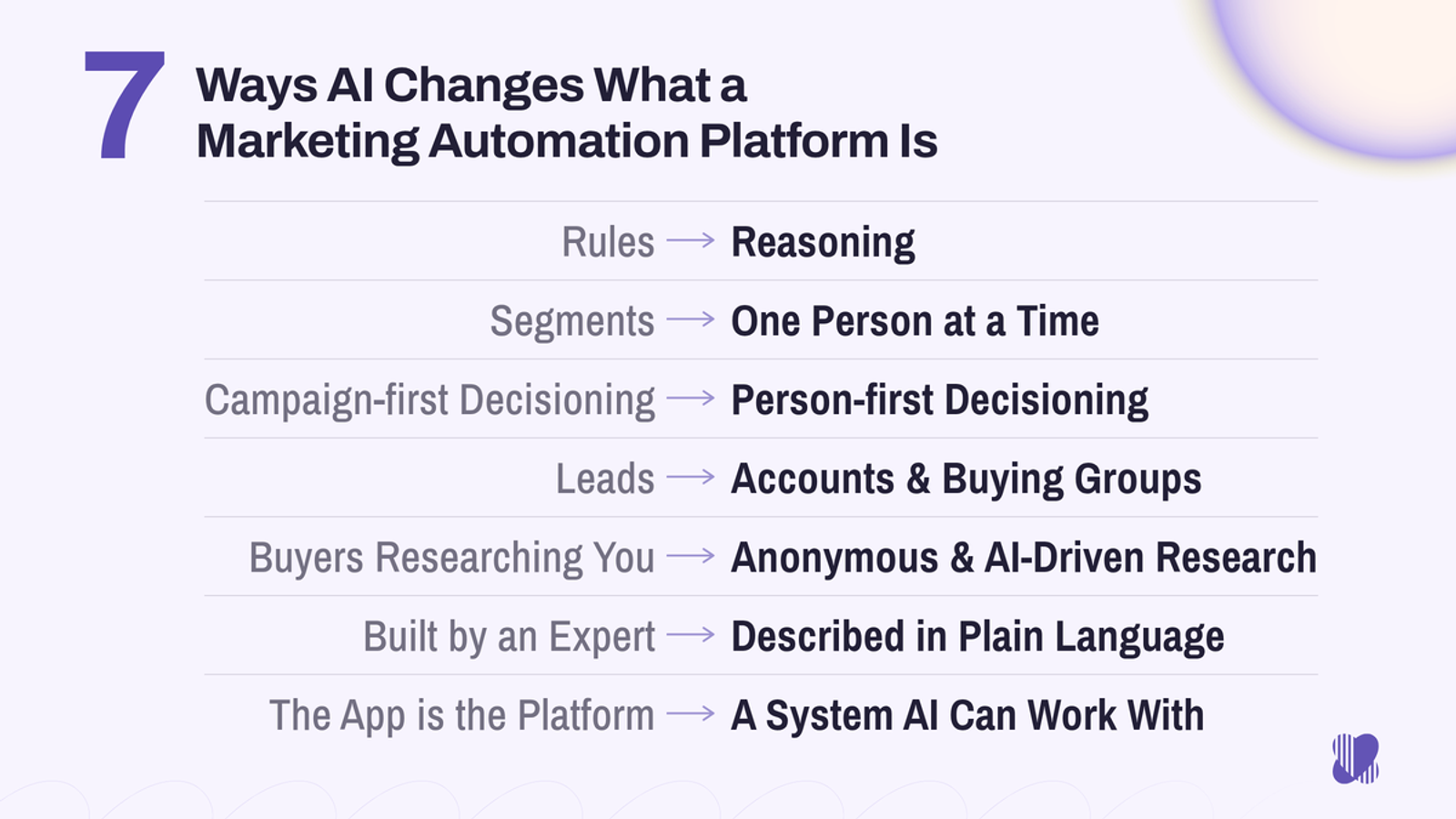
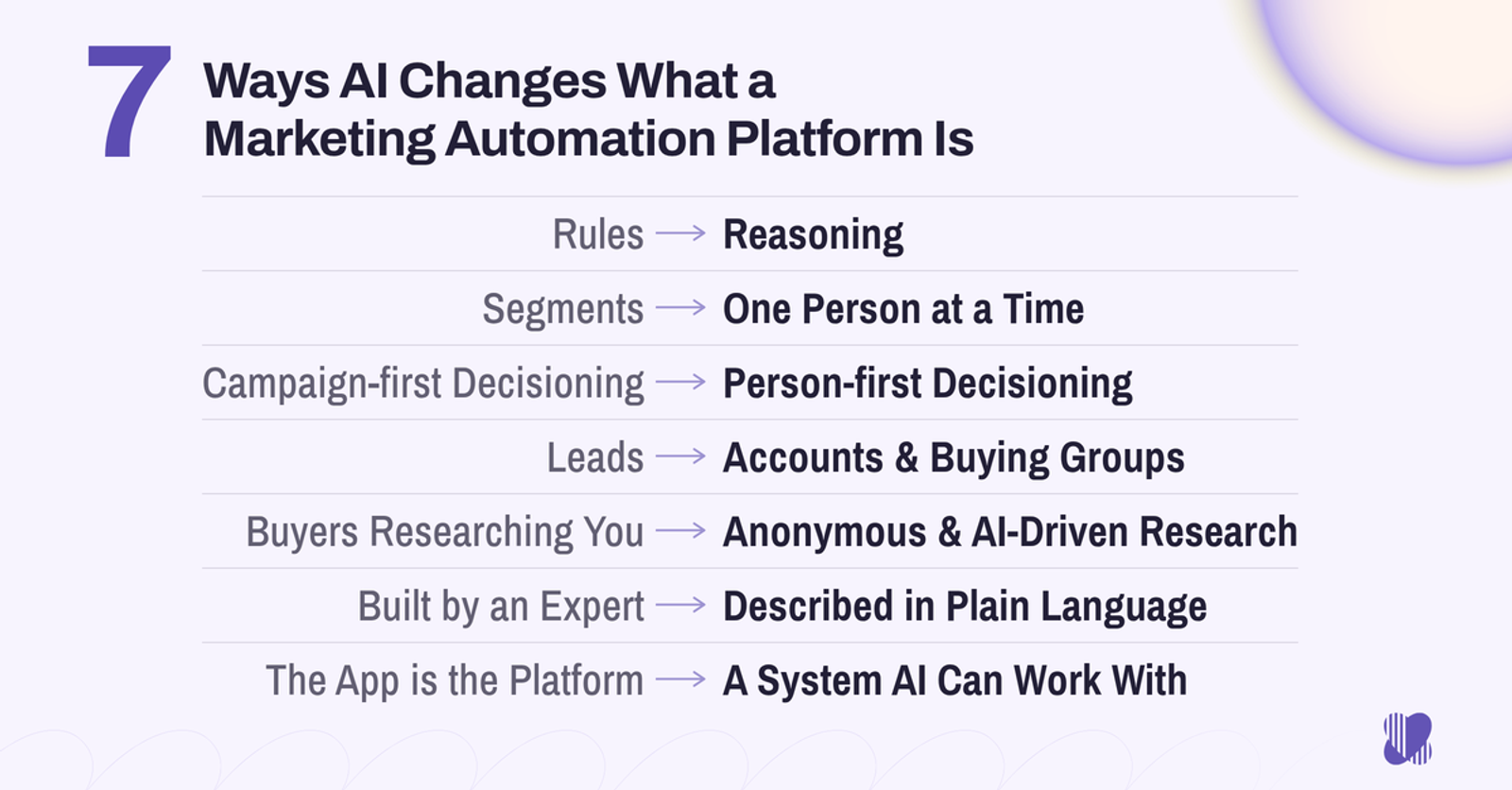
So let's go through the seven ways this changes what a marketing automation platform is.
5. Seven Changes
1. From rules to reasoning
Legacy marketing automation platforms are, at their core, glorified if-then rules engines. If the prospect opens an email, add a point. If they're in financial services, send this sequence. If they fill out the form, start them in this nurture track.
I'm not saying rules are always bad. You want strict governance for things like consent, sending frequency, and permissions. The issue is that rules are good at what's allowed and bad at what's best.
Take normalizing a state field. You need to define every variant explicitly: CA, Cal, Cal., Calif, California, and then handle territories and international addresses. Every gap requires another rule. Now scale that to persona mapping, where the data are ambiguous rather than merely messy. Rules don't handle ambiguity well, so they fail silently or route someone to the wrong place.
Every rule you write to handle an edge case can conflict with the ones already there. Ideas that look clean as a flowchart on a whiteboard turn into spaghetti once they meet real-world complexity, and eventually the logic gets so layered that nobody wants to touch it.
At Marketo, we were of course users of our own platform. We started with a single nurture track, and it was an effort just to write enough emails to stay ahead of a once-a-week drip. Eventually we got to three: one for marketing executives, one for marketing users, one for sales users. But that is as far as we ever got in my time there. Every additional track meant another set of rules deciding who qualified, who got pulled out, and who came back, plus another set of emails to write and keep current. It was just too much complexity, even for my very capable team.
A reasoning system works differently. Modern AI models can look at a LinkedIn profile and an engagement history and determine that a contact belongs to a specific account, without an explicit rule. They understand that Director of Operations means something different at a logistics company than at a software firm. They adapt as new patterns emerge, without a configuration change.
More importantly, they can think. Say a customer in financial services is eligible for two emails today: an invitation to next month's financial services webinar, and an announcement about a new product. Both are good; you can only send one. A rules engine can enforce the limit, but it cannot determine which one is better for them right now.
That's the difference between rules and reasoning. A rule can only check whether something is true. Reasoning can weigh different alternatives against each other, and use judgment to pick the right one.
2. From segments to one person at a time
Rules-based legacy platforms use segments for personalization, but unfortunately nobody is just a segment.
Take those three nurture tracks at Marketo. Even if we built more, they would have still been segments. To get real, individual personalization out of a rules-based system, you would have to map every combination of everything you know about somebody against everything they might do. Which is, of course, impossible. So you build a few journeys for a few segments, and everyone inside a segment gets basically the same thing.
And we've known for a long time what that costs. In a 2009 Marketing Science paper called "Dynamic Customer Management and the Value of One-to-One Marketing," Khan, Lewis, and Singh showed that choosing the right promotion, sequence, and timing for each individual customer made significantly more money than sending everyone the same offers. What they couldn't do was run it at scale, because the computation was out of reach. The math was there in 2009, but the compute was not.
AI unlocks a better way. A reasoning platform can read everything about a person, their account, and their buying group: what kinds of messages they respond to, where they are in their journey, what they're actually using and what they've called support about, what else is happening at that company. That context accumulates on its own, and nobody has to decide in advance which parts of it will matter.
So two people with the same job title at the same company might sit in the same segment, and still get completely different journeys.
3. From deciding who gets a campaign to deciding what each person gets next
Legacy platforms don't start with the person, they start with the campaign. You build one, then you define who should get it.
Now do that a dozen times. What any one person actually experiences is whatever those dozen campaigns happened to send them, each deciding on its own, none of them aware of what has already happened or what else is planned.
This is why serious marketing teams end up building some kind of air traffic control process. You can set communication limits in a tool like Marketo, and they do stop people from getting buried. But whichever campaign happens to mail them first uses up the limit, even when it's the inferior touch. The limit protects the buyer from volume, and does nothing at all about quality.
Quality comes down to four things for every touch: the offer, the channel, the timing, and the content. Generative AI made the last one cheap, which is why inboxes are now full of AI slop, messages that feel personalized and offer nothing.
Offer, channel, and timing matter more. Should this account get a case study or a demo invitation? Should this person get an email or a LinkedIn message? Is this the right moment to reach out, or are you burning a relationship before a genuine buying signal has appeared? You don't need unique text for each person. You need the right action at the right time.
And one action is not enough. Nobody in B2B buys because of one email, which is why real-time next-best-action falls short: it optimizes the current move and ignores the rest of the game. Like a good chess player, you want to look many moves ahead.
An AI-native platform inverts the whole arrangement. It starts from the person and their buying group, takes the goal you've set for them, whether that's driving engagement, booking a meeting, or expanding into a second business unit, and works out the sequence of touches most likely to get there: which offer, over which channel, in what order, at what time. Every campaign your team has built becomes a candidate for that sequence rather than a sender in its own right, so nothing gets sent because it happened to fire first. When a new signal arrives, the sequence gets replanned instead of interrupted.
And because it's planned ahead, you can look at somebody and see what they're scheduled to receive next month. Legacy tools can only show you what happened to them last month.
4. From leads to accounts and buying groups
Legacy platforms are built around the individual lead. One person, moving through a funnel. And that's partly my fault, because we built these systems for a simple linear process: form fill, nurture, score, hand to sales at the right moment.
The problem is salespeople never talk about how many leads they closed. They talk about how many accounts they've closed.
And a B2B purchase gets made by a committee that can easily run to twenty people, all with different roles and different questions, which makes leads too narrow to represent B2B buying. Say four of those people engage with your brand. Legacy marketing automation platforms can't connect that activity, so you generate four MQLs rather than one potential opportunity.
Or say one person downloads ten pieces of content. This would set off every alarm in your scoring model but may mean nothing more than that somebody wanted to read something. Compare that to ten people from the same company visiting anonymously — none of them get flagged, but something is clearly brewing.
ABM fixes that and creates the opposite problem. With ABM, an account is a customer if they own one of your products. But that same company might be a target prospect for a second product, and in a live sales cycle for a third with a completely different set of people. It's a key reason post-sale marketing is so difficult in legacy platforms (along with the absence of the product usage and support data that would tell you what those customers are actually doing).
Similar to the Goldilocks story, leads are too narrow, accounts are too broad, but buying groups are just right.
So why has almost nobody done it? Because assembling a buying group is a judgment call, and rules can't make those. Of the eleven people you know at an account, which ones belong to this opportunity rather than to the renewal? Is this person a champion, an evaluator, or somebody who downloaded a PDF once? Reasoning can work that out from titles, engagement patterns, and what your closed-won committees have looked like before. A rule can only match a title string and hope.
In a platform built for the new B2B playbook, a buying group has to be a real object, not a report you assemble afterward. It gets its own score, its own lifecycle, its own automations. Forrester's Kelvin Gee now evaluates platforms on this directly: whether they can identify, assemble, target, and measure these groups. And because a single account can support several buying groups at once, at different stages, you can finally market the way companies actually buy.
5. From buyers researching you directly to buyers researching you through agents
And those buying groups are getting some new members.
Your buyers increasingly aren't coming to your site to research you. They ask AI, and it does the reading and the comparing and the shortlisting for them. It reads what you publish, forms a view, and carries that view back to the humans.
Legacy platforms have no idea any of this is happening. Everything in them assumes a person took the action. A person opened the email. A person filled out the form. A person read the pricing page.
Marketers have noticed the shift. In Brinker and Riemersma's research for Martech for 2026, 63.1% of respondents said they publish AI-optimized content, while only 13.6% measure AI inclusion rate or agent-referred conversion. So we've changed what we publish, but we can't see what happens to it.
That visibility matters, because when an agent asks for your pricing or your product specs, that's first-party intent. An unknown startup's agent poking around your category is probably noise. A Fortune 500's agent comparing you against two competitors is pipeline, and it should count toward how you read that account.
The next generation of marketing automation has to work with the whole buying committee, and that committee now includes agents.
6. From built by an expert to described in plain language
Most legacy platforms have gotten so complicated that every campaign and every workflow has to be built by a specialist. MAPs like Marketo aren't complex just because of the UI. They're complex because they are a controlled production environment, with institutional knowledge baked into every decision.
Think about what a campaign brief contains: the audience, the message, the offer, the timing. That's a complete specification, but someone still has to translate that intent into a specific implementation using a massive set of company context. Which program template to clone. Which fields to use. Which segments must be suppressed. Which naming convention ensures the campaign shows up in the right reports. So the work queues up behind the few people who hold all of that, which leads to ticket backlogs and long waits from idea to campaign.
But the context they're applying isn't secret. It's the documentation you'd create to onboard a new MOps hire, and at most companies it has never been written down anywhere. Write it down once, and it gets followed every time.
So the next generation of marketing automation is more than a prompt box. Saying what you want is the easy part. The platform underneath has to hold that context and the skills your team works by, so an AI agent can take a campaign brief and execute it. Not by guessing or improvising, but by following your naming standards, your governance guide, your compliance requirements, and your QA checklist. The barrier won't be AI capability. It'll be whether your context exists in a form an agent can use.
The complexity doesn't go away, and it shouldn't, because marketing is complicated. What goes away is the need to be an expert in the platform.
IDC's Gerry Murray expects this to go further, to the point where "single prompts will automatically generate, manage, and optimize processes, projects, and campaigns." He thinks that means fewer marketers. I'd argue it means different ones.
And this is good news for marketing ops. Instead of configuring complex rule chains, MOps teams provide context: setting business goals, defining what success looks like, establishing guardrails for AI decisions. The technical work changes; the strategic value increases.
7. From a platform you log into to a platform your AI can use as well
With legacy platforms, the application is the platform. Getting anything done means logging in and clicking through the screens. There are APIs, but they were built for moving data in and out, not doing actual work.
AI-native is not just about the user interface.
In a modern platform, an ops lead should be able to update automations and scoring rules from Claude. A CMO should be able to ask in Slack where pipeline is stalling and what to do about it. A call recording agent should be able to follow up every customer call by writing what it learned about the account back into the marketing platform, where it changes what that account gets next.
That's exciting, but it might also make you a little nervous, and it should, especially the last one, where no person is involved at all. When any agent can reach the system, the interface stops being where control lives. Permissions, approvals and the record of what happened have to sit in the platform itself, or they don't exist at all.
Scott Brinker describes the same shift from the other side. Platforms used to compete for the marketer's working hours. The next round is over which systems agents can work with. So what you're buying is the system underneath, not just the screen on top of it.
6. Introducing Phave
Any one of those seven changes is a gap you could work around. But together, they are why legacy marketing automation platforms have stagnated even as AI innovation has blossomed everywhere else.
Over the last two years, I've talked to more than 200 marketers who want AI-native capabilities and are frustrated with the slow pace of innovation in their existing platform. So that's why I built Phave.
Phave is AI-native marketing automation.
We built it in stealth, which makes it the first company I've started this way. Everything I've worked on before was announced long before it was real. This time we waited until we had a working product with customers using it, and fifteen enterprise development partners have been guiding our development, using the product, and giving us feedback every step of the way.
Today, we're finally ready to launch Phave and I can’t wait to show it to the world. Here’s what makes it special.
Smart, not scripted
Phave has campaigns, but it doesn't run campaigns. It computes a Playlist for each person and runs that: the sequence of actions most likely to help them and their buying group reach the goal you've set, inside the guidelines and communication limits you've given it.
Gartner expects this to become normal quickly: by 2028, 60% of brands will use agentic AI to deliver streamlined one-to-one interactions. Emily Weiss, the Gartner researcher behind that prediction, says it marks "the end of channel-based marketing as we know it."
A Playlist assembles in layers. Communication limits come first, by segment if you want them that way. Then the campaigns your team scheduled deliberately, each with a window saying how far its date is allowed to move. Then Maestro fills whatever slots are left, choosing the best sequence rather than just the best next thing, and reading the whole buying group rather than the person alone. It plans thirty days ahead, and recomputes whenever new information comes in: a stage change, a campaign response, even a touch from another system.
Spotify doesn't write new songs, and neither does Phave. Campaigns are the albums, made and approved by your team, and the Playlist mixes them into the right order for each listener.
Phave writes down what it learns about each person, account, and buying group, and uses it the next time a decision comes up. We call them Maestro Memories, and Phave can hand that same context to the other applications and agents your company runs.
You decide how much of this runs on its own. Keep everything scheduled and Phave works the way a MAP always has. Leave nothing fixed and the system runs itself on autopilot, following your guidelines. Most teams start by giving it a little flexibility and expand over time.
By the way, reasoning isn't only for Playlists. It does the segmentation, the scoring, the routing, the persona mapping, and the data quality work too. Rules keep the job they're actually good at: what's allowed. Things like consent, frequency, and quiet hours never become judgment calls.
Built for the new B2B playbook
In Phave, a buying group is a real object with its own score and its own automations, and qualified buying groups and marketing qualified accounts replace the MQL. When a group qualifies, something actually happens: an alert, a task, a campaign.
Signals aggregate at all three levels, so a person's behavior counts toward their account and their buying group, roles get inferred from what people actually do rather than from their titles, and anonymous activity still tells you something at the account level.
Buying groups also help unlock post-sale marketing. The committee that expands an account isn't the committee that bought it, and Phave can run both at the same time on the same account. It also holds the product usage and support history that marketing to customers requires, so expansion runs on what someone is doing with your product rather than on what they downloaded before they bought.
Deep, not difficult
Marketing automation historically made you trade power for ease of use. Marketo complexity, or HubSpot simplicity. We've fixed that, and not by making the product do less. Phave is easy to use, because the interface was built for marketers by people who have spent twenty years watching what works in these products and what needs fixing.
But the interface was never the main reason legacy platforms are hard. The real difficulty is everything you have to know before you can build anything: the naming conventions, which segments to exclude and why, what a webinar campaign means at your company.
In Phave that lives in Skills, written the way you'd explain it to a new hire rather than configured, and Maestro follows them every time it builds something.
Chat in other platforms is a small set of scripted intents: draft a subject line, summarize a report, answer a help question. Ask them to change something and they tell you how to do it yourself. Two things make Maestro different. Everything the interface can do is exposed as one of 300-plus governed operations, and your Skills say how your team does that work. So Maestro, or any AI agent, can operate the product rather than sit next to it.
That's why Phave has four doors. Your marketing team works in our app. Anyone who'd rather chat than click uses Maestro Notebooks, where the answers come back as the same charts, lists, and campaign views they'd see in the app. Or they can connect over MCP and use Phave from their favorite chatbot. And your AI agents can drive Phave headless, through MCP or the API, with no interface at all. Same capabilities, same context, same guardrails, whoever is asking.
Whichever door it comes through, an agent connects as a specific person rather than as a service account, so it can only do what that person can do. Every action carries a risk class, so anything consequential comes back to a human before it runs, showing exactly what it will affect. And every decision is recorded, including what the system chose and what it rejected.
And Maestro doesn't wait to be asked. Every night it reviews everything running and brings you what you'd otherwise miss: response rates sliding, a tactic underperforming, two campaigns competing for the same people. Each one arrives with the evidence attached and the fix already built, ready for you to approve.
Nothing lost, plenty fixed
Nobody switches marketing automation platforms for fun. The real fear is discovering in production that something the team relied on is missing.
My team and I helped build Marketo. Nick Bonfiglio, our co-founder and CTPO, ran product and engineering there. So we knew what enterprises need from a platform like this.
Then we checked our work. We gave Claude twelve enterprise evaluations and asked it to synthesize the requirements and to weight each one by how much it matters in a real buying decision. Six came from prospects, five we found online, and one was Forrester's requirements for Revenue Marketing Platforms. That produced 481 requirements, and Claude scored every platform against every one of them, 0 to 4, where 3 means fully supported and 4 means differentiated. Nobody at Phave decided which requirements counted or what they were worth.
Phave came out at 2.97, against HubSpot at 2.46, Salesforce MCAE+ at 2.45, Marketo's 2.38, Eloqua's 2.32, and Pardot's 2.03, plus Conversion.ai's ~2.2, and Inflection.io's <2.0 score. And Phave matches or beats every one of them on at least 90% of the 481: 90% against Marketo, Eloqua, and HubSpot, 94% against Pardot, and 97% against Inflection.io and Conversion.ai.
Then there's what gets better. Legacy platforms carry twenty years of quirks their customers have learned to work around. A bulk update that burns the CRM API allowance and backs up the queue for everyone. Sync that steps over records without saying so. Bot traffic inflating engagement and moving scores. Rules that fire in an unpredictable order. None of that is inevitable. It's the cost of an architecture built for a different era, and a platform built now doesn't have it.
For the people who will ask: SOC 2 Type 2, SSO and custom roles, every customer's data in its own database schema an admin can inspect, and no customer data training a model.
You don't give anything up by coming to Phave, and we fixed a lot of the things that annoy you.
7. The One-to-One Future, Finally
I've spent my career trying to build the ultimate marketing platform, and I've been lucky to work on some good ones. Epiphany. Marketo. Engagio. Demandbase.
Each of them got closer, and each of them hit the same wall: software that follows rules can only get so far.
This finally is one-to-one marketing. Now, thirty-three years after Peppers and Rogers proposed the concept, reasoning AI lets us deliver corner-store attention at industrial-era scale. The grocer managed a few hundred people. Phave manages every person, account, and buying group, one at a time.