Here's what a marketing harness means for B2B
Most vendors describe a marketing harness as a faster way to produce content. In B2B, the harness that matters decides, coordinates every agent, and learns across the whole buying group.
It's become trendy for martech vendors to describe themselves as a marketing harness.
It makes sense. Software engineering learned over the past year that the magic in AI coding didn't come from better models — it came from the system built around the models: the context, the tests, the integrations that make the AI actually useful. A model in a chat window can help you plan a trip. Inside a coding agent, it can read the codebase, run the tests, fix what fails, and ship a working feature.
That's called a "harness" and it's where a lot of people, including investors, think a lot of AI value will be created.
So of course smart marketers (including Phave!) are jumping on the wagon.
And I agree with much of what the other vendors are saying about marketing harnesses. A harness should work with a team's existing process instead of replacing it. It should learn from what reviewers approve, edit, and reject. It should enforce approvals and keep a record of every action.
But... most of the other vendors describe a harness as a tool for producing campaigns and content faster, and most of their examples come from B2C marketing. This highlights three key limitations in their frameworks:
- Producing content is useful, but to me, making orchestrated decisions is even more valuable.
- B2B companies have unique requirements that a B2C or generic vendor can't properly handle, including navigating complex buying groups and long buying journeys where outcomes happen months to years later.
- Most companies will run many AI agents from different vendors, and those agents need a shared harness to coordinate how they reach the same buyers.
In this article, I'll explore all three of these limitations and define what a B2B harness that's purpose-built for B2B should look like.
What are the six components of a B2B marketing harness?
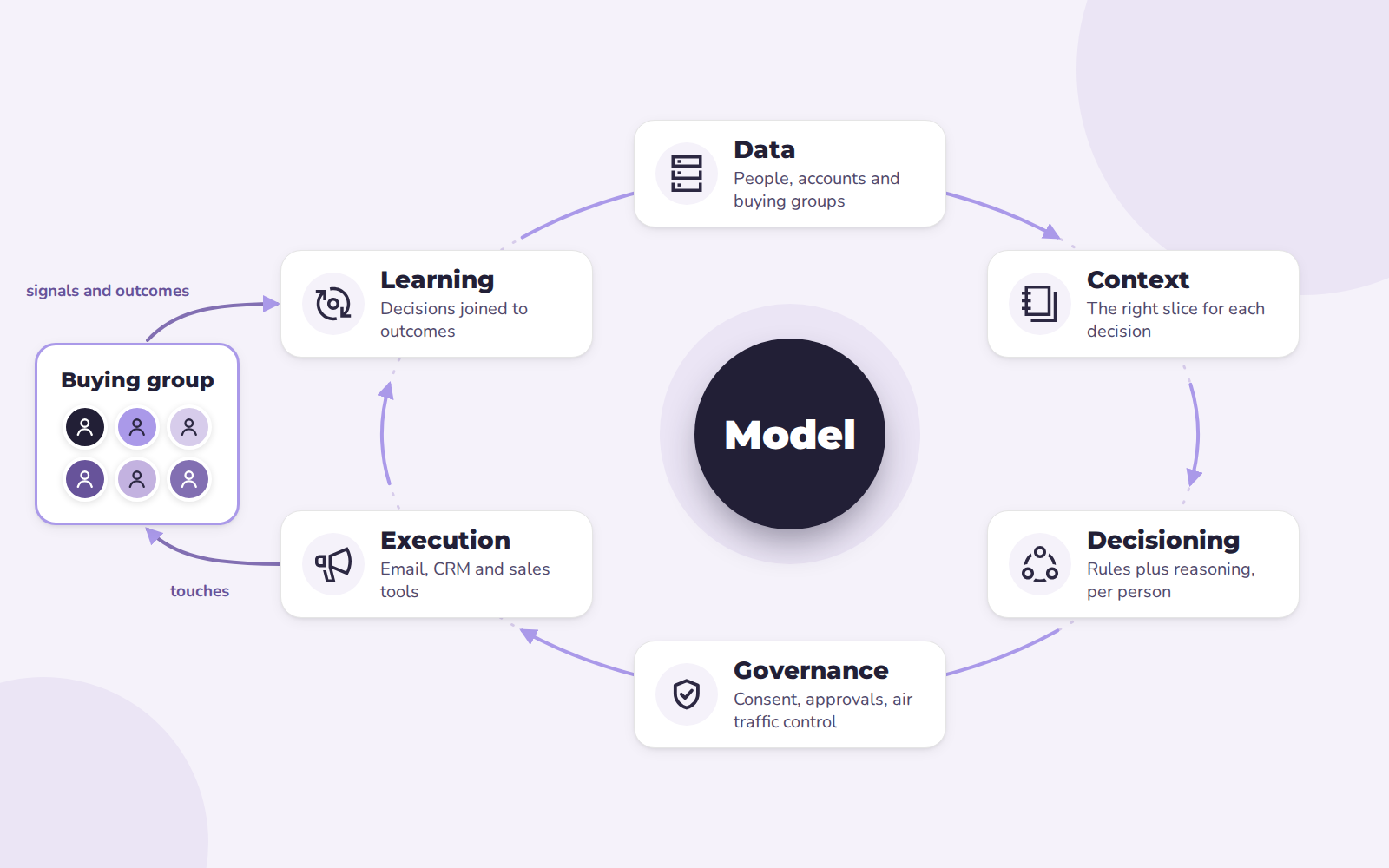
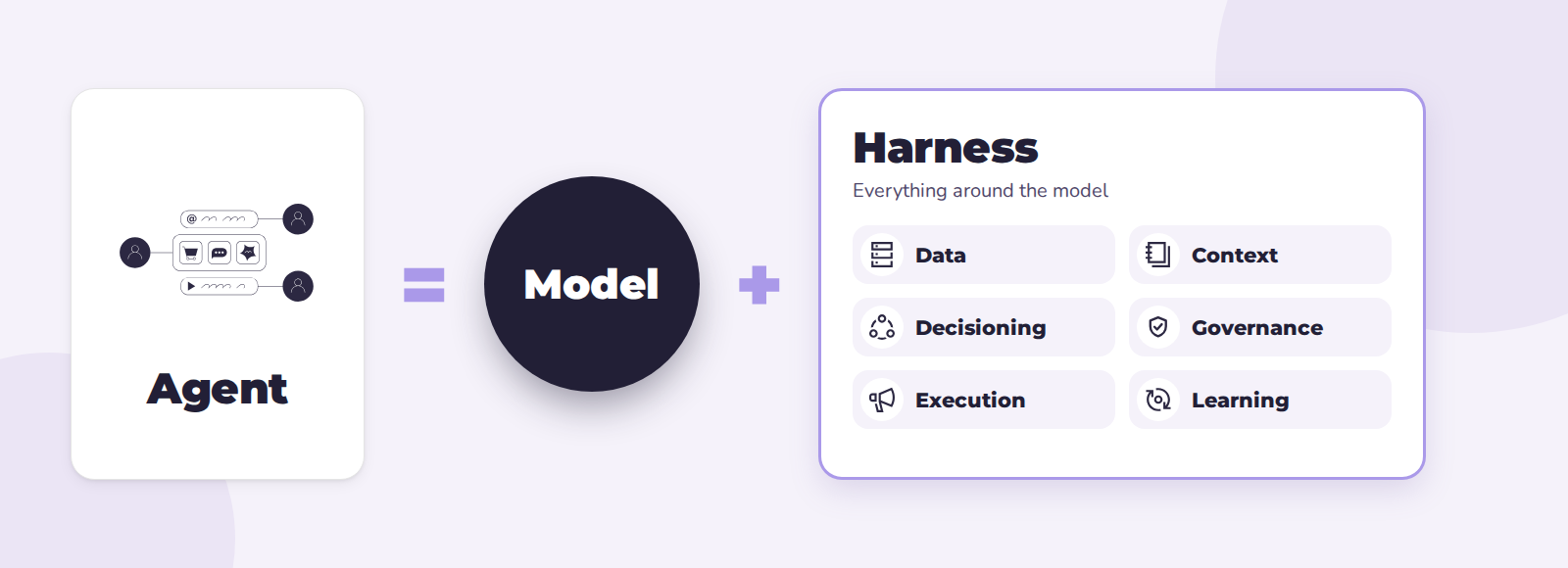
A B2B marketing harness is everything around the AI model that lets it run B2B marketing a company can trust: the data and context it reasons from, the decisions it makes about each person, account, and buying group, the governance every action passes, the execution that reaches buyers, and the learning that improves the next decision.
A B2B harness has six components, arranged in a virtuous loop.
Data: In a B2B marketing harness, data is the shared record of the people, accounts, and activity the AI works from. B2C harnesses have data about people and engagement, but a B2B one also needs accounts, buying groups, opportunities, intent signals (1st party and 3rd party), and more.
Context: Context is the information a B2B marketing harness gives the model for each decision. That includes the facts about the person, account, and buying group (and how they relate to each other) as well as the company's goals, playbooks, guidance, and approved content; skills that encode how to do a task; memories of past decisions and corrections; and the tools/integrations the model may use. Also, a model can't (and shouldn't) consider everything a company knows every time, so for each decision the harness retrieves the context that matters, keeps it current, condenses what runs long, and fits it into a limited budget. Engineers call this context engineering.
Decisioning: Decisioning, sometimes called AI decisioning, is how a B2B marketing harness turns the model's reasoning into decisions. Some apply to any kind of marketing: who to target, what to create, what each person receives, when it goes (and whether anything should go at all). B2B adds an additional set of unique decisions: which accounts to prioritize, who is missing from the buying group, where each person and buying group is in its lifecycle, and who owns the follow-up. Each decision works toward an objective, follows the rules that apply, and uses reasoning for the cases no rule covers. When confidence is low, the harness escalates to a person.
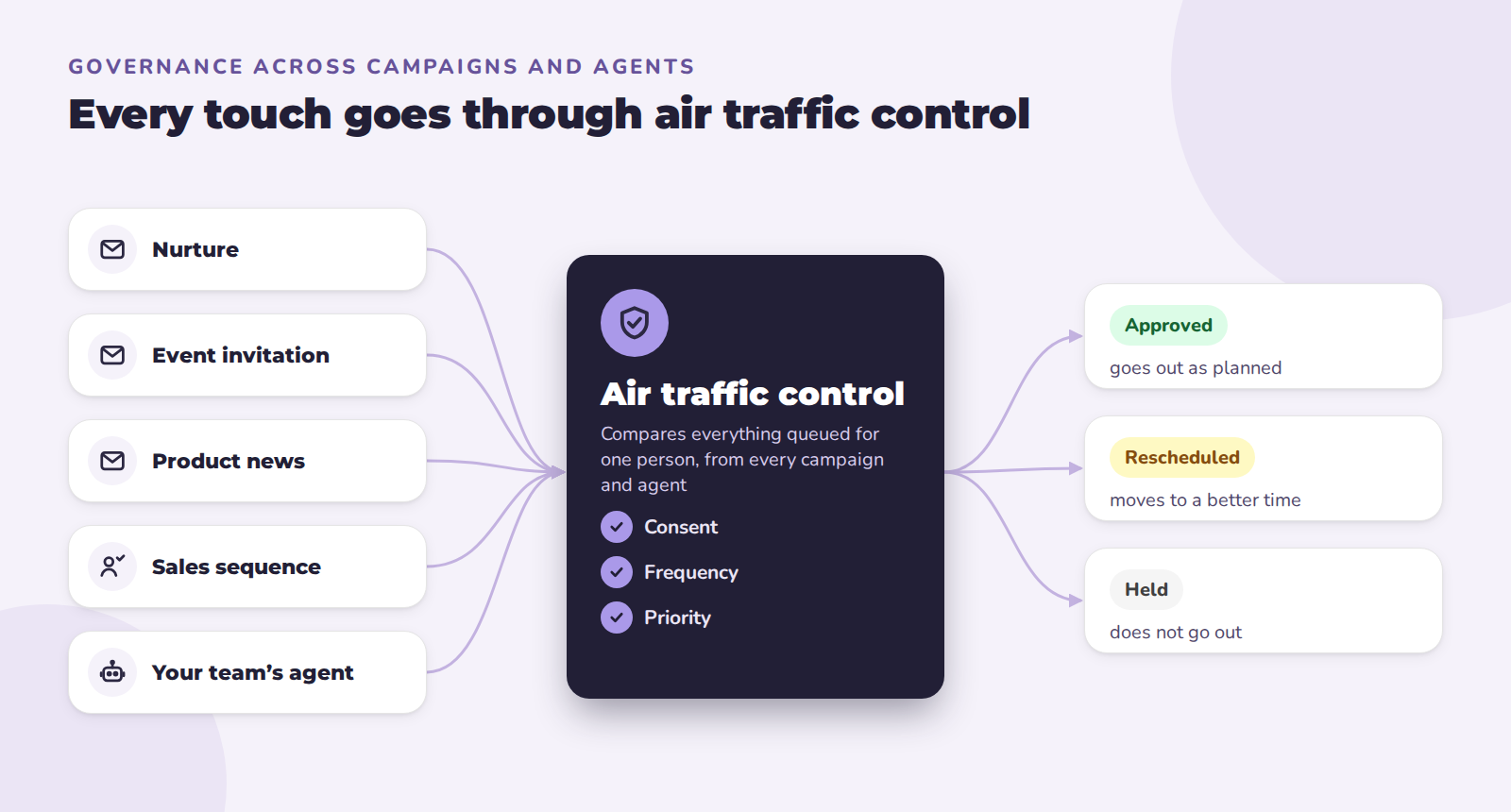
Governance: Governance is the set of checks a B2B marketing harness applies before anything reaches a buyer. Every proposed action must be checked for things like consent, permissions, budget, and approvals. Content gets its own checks like brand voice, legal review, and all claims grounded in approved sources. Governance should also include "air traffic control", which checks everything queued for a person across every campaign and every agent before anything goes out. In B2B, these rules apply to the buying group as well as the person, and a sales rep's active sequence should be part of the air traffic control.
Execution: Execution is where a B2B marketing harness builds and acts on its decisions. It creates campaigns, segments, and pages, drafts and personalizes content, and takes action via integrated tools such as email, CRM, sales tools, and other channels. B2B brings a unique set of integration requirements, including CRM and sales tools, LinkedIn, webinar and event platforms, and more.
Learning: Learning is how a B2B marketing harness gets better with every decision. Every decision should be recorded with the options considered and the reason for the choice, as well as what happened (and whether the human changed it). This is called a decision trace, and it feeds into the facts and memories (context) for future decisions, creating a continuous closed-loop of learning and improvement. Of course, outcomes are tricky in B2B since pipeline and revenue at the account level can take months, so the harness has to measure each decision against opportunities, not clicks.
Why is decisioning the most important job of a B2B marketing harness?
A marketing harness should produce content, and a good one does. It drafts emails and pages to the brand's standards, routes them for review, and learns from the edits.
That makes you more efficient, but I think becoming more effective is even more exciting. That's why decisioning is core to a marketing harness.
Legacy marketing platforms make decisions with rules. The problem is that rules are good at what must be true, but they don't handle ambiguity and judgment very well — and real B2B buying is full of that kind of complexity.
Say a VP gets a nurture email, an event invitation, and a new sales sequence in the same three days. Each rule matched its own campaign's criteria, but nothing compared what the VP would receive in total.
You probably have sat in an "air traffic control" meeting that tries to fix this, mapping out all the campaigns, deciding who is emailing which list, and deciding which sends gets prioritized. A content harness doesn't solve this problem, because each of those emails is still on-brand.
That's why a key purpose of a B2B decisioning harness is handling air traffic control across campaigns, tools, and channels. It checks everything queued for a person, regardless of which campaign or agent proposed it, and approves, reschedules, or holds each touch, based on the objectives and governance rules that you set.
How much human review do AI marketing decisions need?
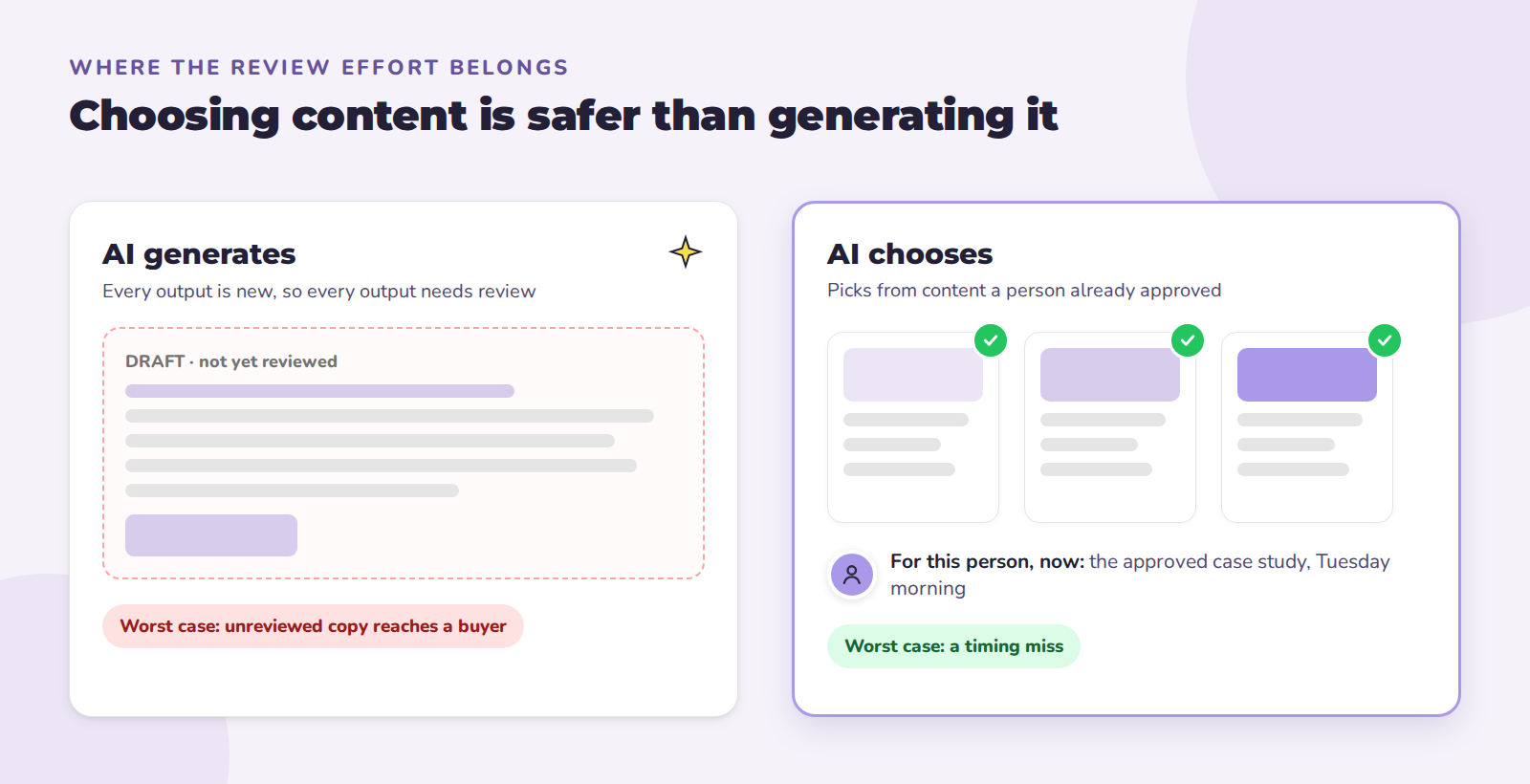
Decisioning also changes how much review AI needs. When AI generates or personalizes content, every output is new — which means every output can be wrong but in a new way. It also dramatically increases the risk of sending out AI slop that can hurt the brand more than help it.
On the other hand, if you use AI reasoning to choose from approved content for the right person at the right time, the worst thing that could happen is sending something a human already approved. And you have the opportunity to take the right action at the right time, which is proven to deliver better results than content personalization.
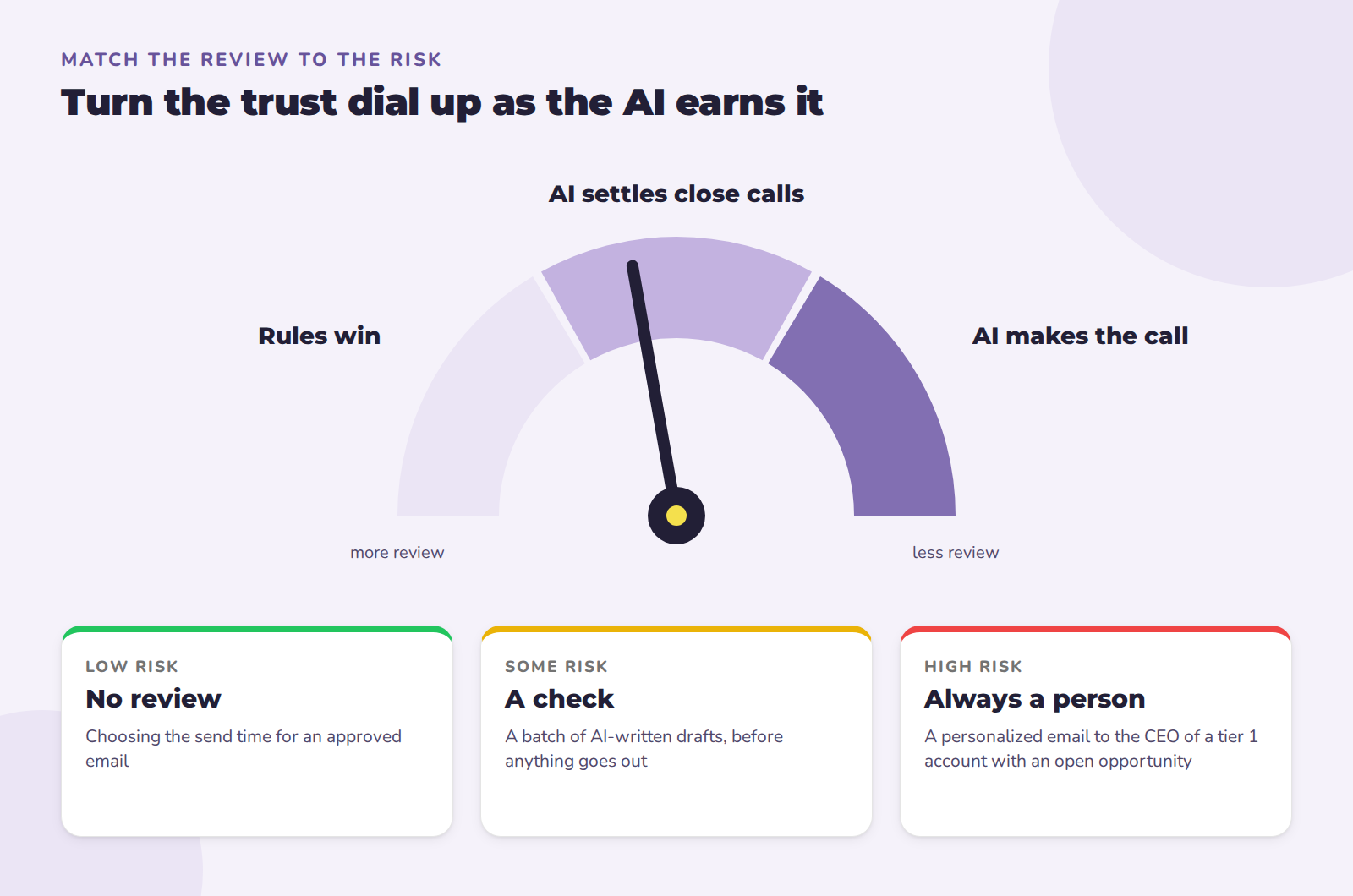
That's why I think your review process should match the risk of each decision:
- Choosing the best send time for an approved email probably needs no review.
- A batch of templated emails lightly personalized by AI needs a quality check before anything goes out, but as in any QA process you probably don't need to review every single one.
- A highly personalized email to the CEO of a tier 1 account with an open opportunity needs a human check every time.
A B2B marketing harness should let a team manage this with what I call a trust dial. For each kind of decision made by the AI (scores, stages, account matching, routing, what to send next), the humans should decide whether to (a) always follow rules, (b) let AI make the decision, or (c) follow rules where it's clear but let AI weigh in when it's ambiguous.
Most teams start with the dial set conservatively and review almost everything. But as reviewers see how the AI is working and which kinds of decisions keep coming out right, they turn the dial up, while keeping the highest-risk decisions with a person no matter what.
How does a B2B marketing harness work with other AI agents?
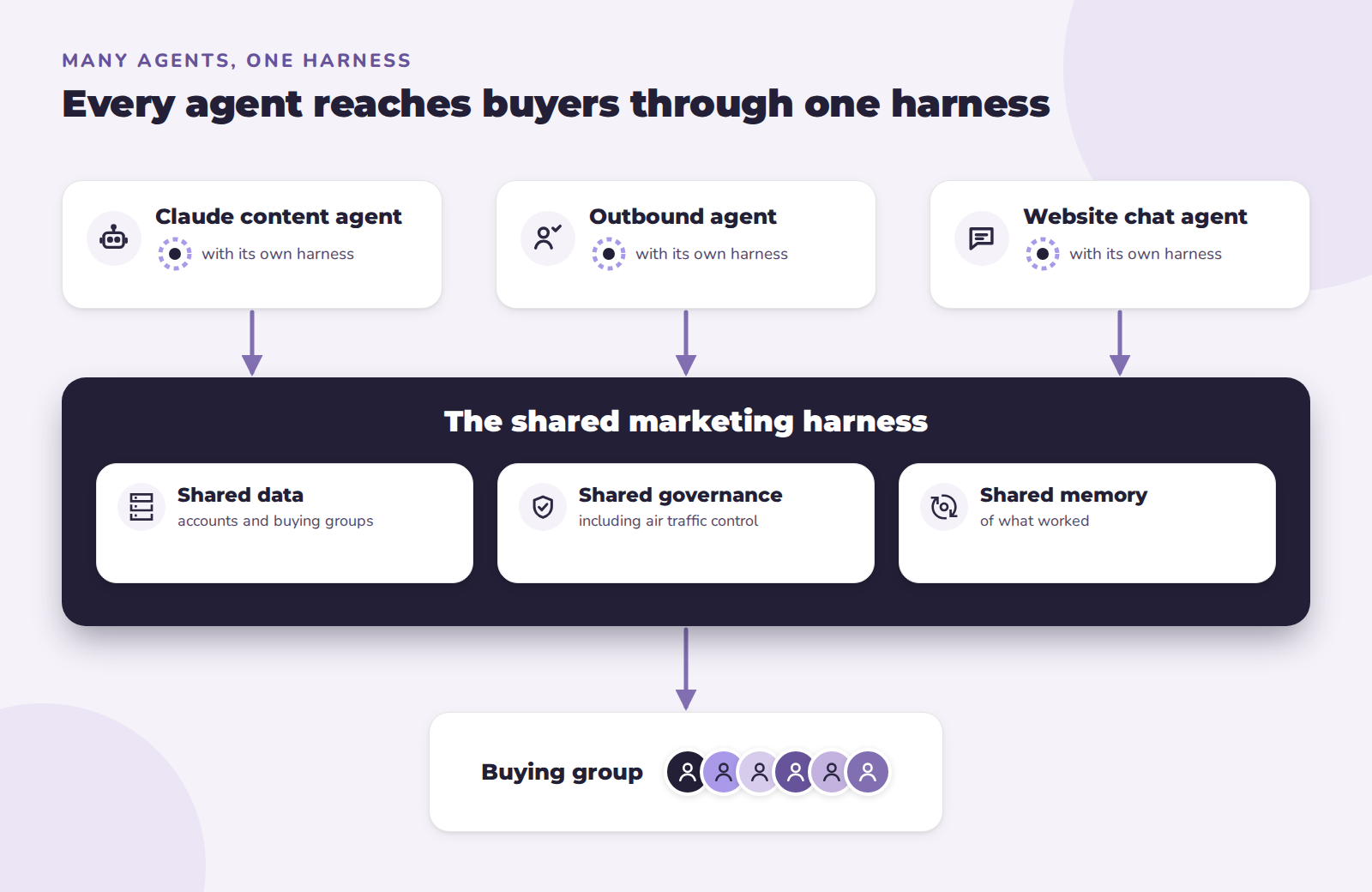
The three-emails-in-three-days problem gets worse when the touches come from different tools. Most marketing teams will likely end up using multiple agentic platforms, not just one harness to rule them all. A team might have homegrown Claude agents to create on-brand content, research customer personas, and automate reporting, plus third-party agents to build and test landing pages, do outbound prospecting, and chat with website visitors. Each may call itself a harness, but none are built to coordinate with the others when several of them reach the same buyer.
Say the marketing team sends a webinar invitation written by its Claude agent, the outbound agent starts a prospecting sequence to the same account, and the chat agent offers the VP a demo on the website. Each works from its own list, rules, and view of the buying group, so the VP will hear from all three in the same week, and none of the agents will learn from the others' results.
What's needed is a meta-harness. Victor Savkin at Nx describes this for engineering as a layer above any single agent that gives a view across every system and a record of every decision, so agents can build on each other's work.
B2B marketing needs its equivalent: every agent that acts on a buyer should work through one shared meta-harness, with the same data about people, accounts, and buying groups, the same governance including air traffic control, and the same memory of what worked.
How does marketing automation become a B2B marketing harness?
This is how I see Phave's own path.
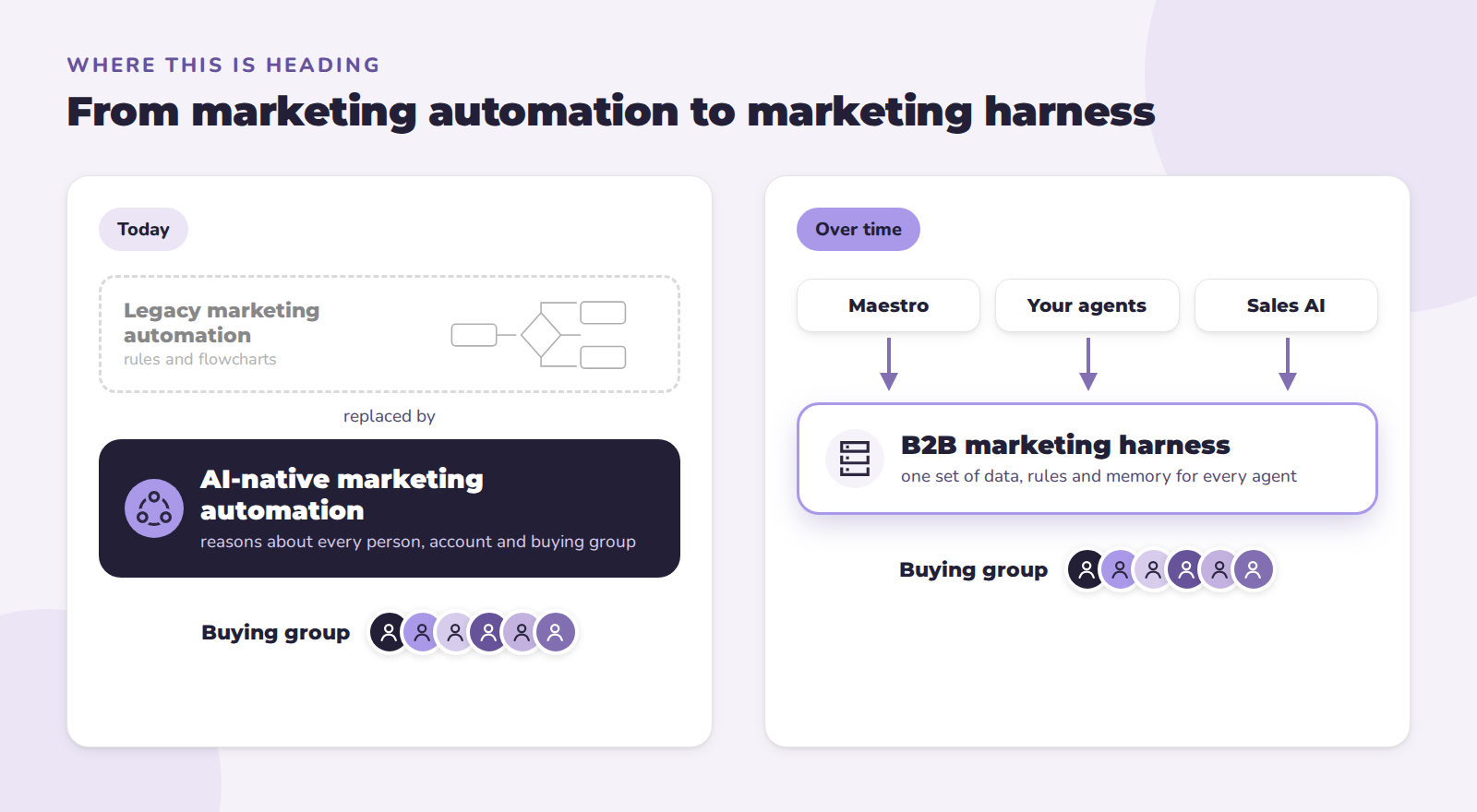
Today, Phave is AI-native marketing automation. Unlike legacy platforms that use rules and flowcharts, Phave's AI reasons about every person, account, and buying group, so marketers describe what they want and Phave works out the rest. That combination of more intelligent decisions and faster execution is what it takes to replace a legacy marketing automation platform.
Under the hood, though, what we've built is a B2B marketing harness as I've described it here. The data, decisioning, governance, and learning that make a better marketing automation platform are the same components a shared harness needs.
That means our customers don't have to choose between buying and building. They can buy the marketing infrastructure they need and build agents on top of it.
Every company can use the same models. In B2B, the advantage comes from a harness that decides, coordinates, and learns across the whole buying group.
Frequently asked questions about B2B marketing harnesses
What is a B2B marketing harness?
A B2B marketing harness is everything around the AI model that lets it run B2B marketing a company can trust. It supplies the data and context the model reasons from, turns its reasoning into decisions about each person, account, and buying group, checks every action before it reaches a buyer, executes the work, and learns from the results.
How is a B2B marketing harness different from marketing automation?
Traditional marketing automation runs rules and flowcharts that marketers build by hand. A B2B marketing harness puts an AI model at the center and surrounds it with data, context, decisioning, governance, execution, and learning, so the AI makes decisions for each person and buying group within rules the team sets.
What is the difference between a content harness and a decisioning harness?
A content harness helps teams produce on-brand campaigns and content faster. A decisioning harness decides what each person should receive, when, and whether anything should go at all, and coordinates every campaign and agent trying to reach the same buyer. A complete B2B marketing harness does both.
What is air traffic control in marketing?
Air traffic control is the part of a B2B marketing harness that checks everything queued for a person, across every campaign and AI agent, before anything goes out. It approves, reschedules, or holds each touch based on the objectives and rules the team sets, so one buyer doesn't get three messages in the same week.
What is a trust dial?
A trust dial sets how much a B2B marketing harness lets AI decide on its own. For each kind of decision, the team chooses whether rules win, the AI decides, or rules apply where the case is clear and the AI weighs in when it's ambiguous. Teams turn the dial up as the AI proves reliable, and the highest-risk decisions stay with a person.
Why does B2B need its own marketing harness?
B2B purchases involve buying groups, accounts, and sales teams, and outcomes such as pipeline and revenue can take months to arrive. A B2B marketing harness works with buying groups and accounts, coordinates with sales and the CRM, and measures each decision against opportunities rather than clicks.