B2B Personalization and the 40/40/20 Rule
Direct marketing's 40/40/20 rule says the list and the offer account for most of your result, and the creative for the rest. A Playlist starts with the person rather than the campaign, which turns the offer and the timing into decisions instead of a schedule.
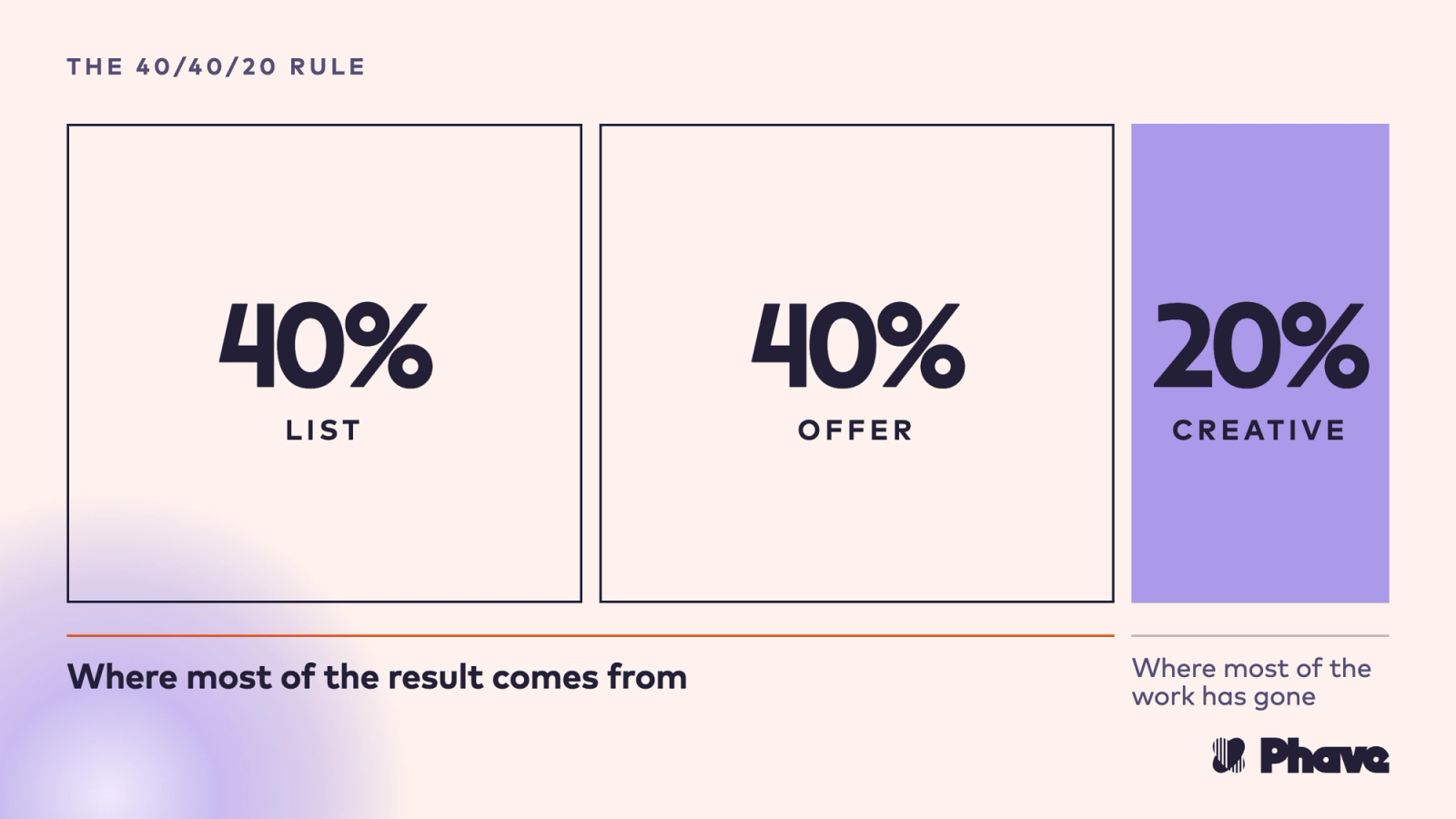
Why a Playlist optimizes the offer and the timing rather than the copy.
The rule, and the flip
Direct marketers have used the same rule of thumb for sixty years. 40% of your result comes from the list, 40% from the offer, and 20% from the creative. It is usually credited to Ed Mayer, and its point is that strategy beats aesthetics. A plain postcard sent to the right people with an offer they want will outperform a beautiful brochure sent to the wrong people with a weak one.
Almost everything B2B marketing has automated in the last twenty years belongs to that 20%.
A marketing operations reader will object to that immediately. Segmentation is the list, and platforms automate segmentation. What they automate is building it. A segmentation rule executes a decision somebody already made about who belongs together, and it makes no decision of its own about who should receive what. The offer works the same way, since the platform delivers whichever asset the campaign was built around. Timing was never optimized at all. It was scheduled, and the schedule was the same for everyone in the track.
So what twenty years of marketing automation automated across all three parts is the labor of delivery. What it automated inside the creative is the decision itself: which subject line, which image, which paragraph swaps in for which industry.
The other 80% went unoptimized because optimizing it means deciding for one person at a time, and a rules engine decides for groups. I've argued elsewhere that this is architectural rather than a failure of effort or investment. This article goes underneath that argument, to the mechanics of why per-person decisions were out of reach and what becomes possible now that they aren't.
A Playlist reverses the order of operations. Rather than building an offer and then choosing who receives it, you start with a specific person and work out what they should get and when. The list has one member, so the list is right. The remaining questions are which offer and which moment.
No percentage attaches to that claim. The research below is about direct marketing generally rather than a measurement of what any platform delivers, and I'm not going to invent a number for something nobody has measured yet.
Everyone is optimizing the 20%
Generative AI made creative personalization close to free, and the industry put the savings into the one part of the rule where more is not reliably better.
Gartner's research found that personalization done properly increases the likelihood of a high-quality deal by 12%, and that certain forms of personalization reduce purchase likelihood by as much as 15%. Both halves of that matter. The return on personalizing the creative is two-sided, which means the volume of it is not the variable. Doing it well helps. Doing it the wrong way costs you more than not doing it.
The AI SDR tools are the clearest case. They reference a job title, a funding round, a recent post, and produce a message that is unmistakably about you and offers you nothing. The recipient can tell within a sentence that the specificity was assembled rather than considered. That is what most people mean by AI slop. The writing is usually fine. The effort went into the wrapper, while a rule firing on a trigger chose the thing inside it.
Meanwhile the questions that account for most of the result go unasked. Should this account receive a case study or an invitation to a demo? Is this the right week to reach out, or are you spending a touch now that would have been worth far more after a signal that has not arrived yet?
Nobody optimized the 80%
A rule has to be written before the case occurs, which means somebody has to know the case in advance. So a business enumerates its cases, and the arithmetic gets away from you quickly. Take six dimensions you actually know about a person: their role, their seniority, their industry, the topic they've shown interest in, their engagement pattern, and the stage their buying journey has reached. Four meaningful values on each of those is more than four thousand combinations. Real relevance needs all six considered at once, for every person, every time a decision comes up.
Nobody maintains four thousand rules. So teams do the only available thing, which is to collapse the dimensions until the number is small enough to build. Pick the two that seem to matter most, accept that the other four are noise, and run three or four tracks.
At Marketo we ran three: one for marketing executives, one for marketing users, one for sales users. That was as far as we ever got, with a good team who were experts in the product.
The three segments were real, and each did respond to different material. What the collapse costs you is the difference between the people inside a track. Two operations directors at similarly sized companies are in the same track, and one is building a shortlist while the other has not yet recognized the problem. Both receive the same email on the same day, because that was the day the track sent.
The flowchart
The visible symptom of all this is the flowchart.
It starts beautifully. Somebody draws the journey on a whiteboard, and on a whiteboard it is a clear picture of how a thoughtful marketer wants to treat a buyer. Then it meets the tool, and every branch acquires a condition, and every condition acquires an exception, and the exceptions begin to conflict with each other. Six months later the diagram is spaghetti, nobody wants to modify it, and the person who understands it has become a single point of failure.
Several of the newer AI-branded platforms put a flowchart in the interface and treat it as a feature. If you are evaluating a vendor and they show you a flowchart for how they manage customer journeys, start asking questions. A flowchart is a picture of decisions a human made in advance. Putting a modern rendering engine behind it does not change what it is. The limit it describes is the same limit Marketo had in 2010.
What the 80% actually requires
Four things determine the quality of any individual touch: the offer, the timing, the channel, and the content.
Mayer's rule names only two of them. Direct mail had one drop date and one channel. There was no timing decision to make, because everyone on the list received the mail when the mail went out, and there was no channel decision because there was one. Two of the four things that matter most in modern nurture are absent from the rule because the medium it describes had no way to vary them. Putting timing with the list is my own observation rather than part of what Mayer said. A list is only a list at a moment.
The research on this is older than most people expect. In a 2009 Marketing Science paper called "Dynamic Customer Management and the Value of One-to-One Marketing," Romana Khan, Michael Lewis and Vishal Singh compared marketing decisions made for each individual customer against the same decisions made at the segment level and at the mass level. Choosing the promotion, the sequence and the timing per individual produced meaningfully better financial results than sending everyone the same offers. The study used an online retailer and its promotions, so it is not a B2B finding. The authors also wrote at length about the computational difficulty of running it, which in 2009 was what stood in the way. The math was available seventeen years ago. The compute was not.
Playlists
Phave has campaigns and does not run campaigns. It computes a Playlist for each person, thirty days ahead, and runs that.
A marketer writes the objective first, in plain language. Engagement, pipeline, win rate, keeping and growing an existing customer. Each one includes its own guidance describing how to pursue it, and objectives can differ by segment, so what Maestro optimizes toward for a new prospect is not what it optimizes toward for a customer eighteen months into a renewal cycle.
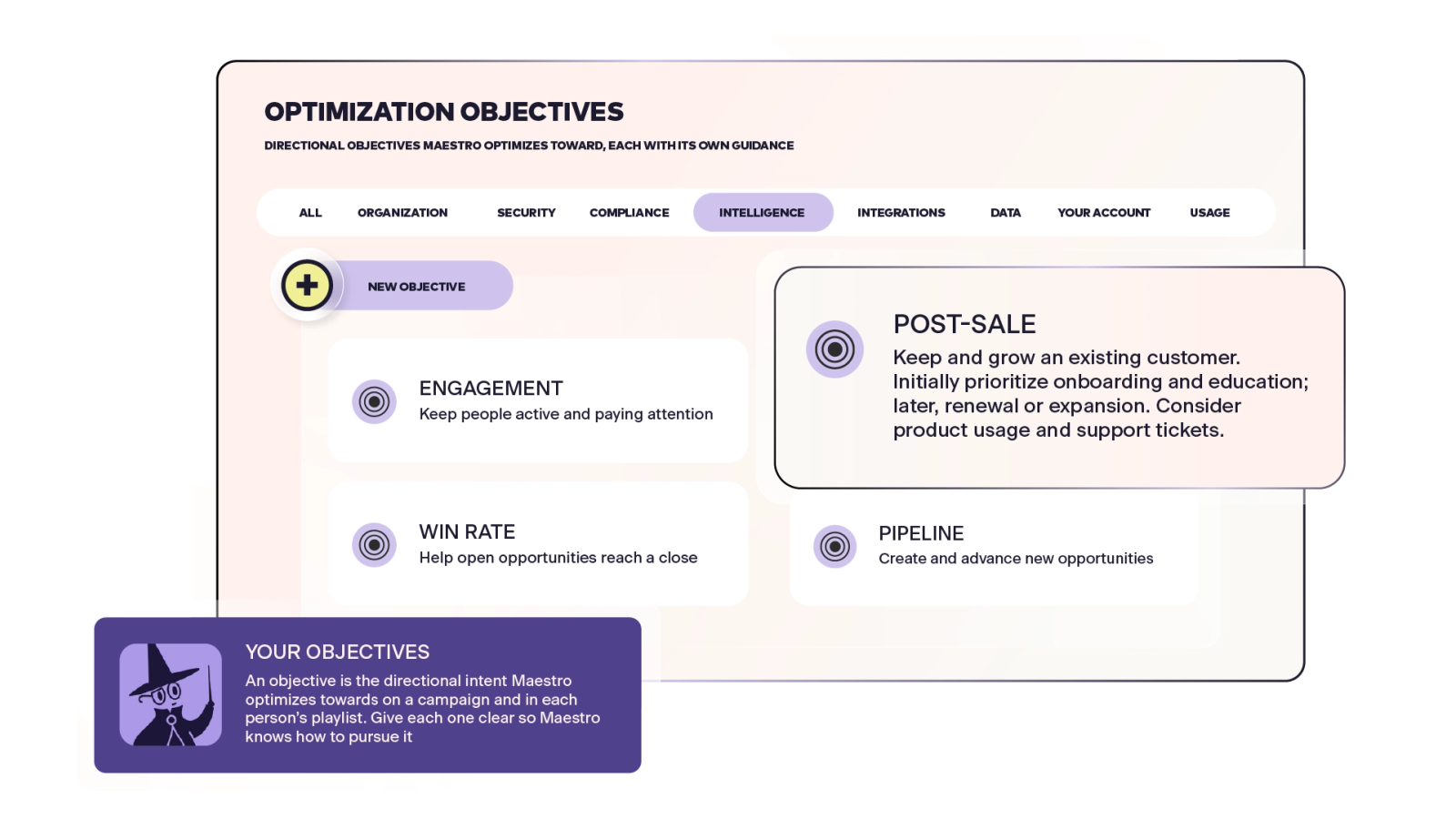
Maestro then plans a sequence rather than a next action. Somebody who downloads a pricing guide on Tuesday might be scheduled for a customer story the following week and a demo invitation the week after, in that order, because that order is what reaches the objective. When something new arrives, Maestro replans the whole sequence rather than interrupting it: a stage change, a response, a touch from another system entirely. A recommendation engine picks the best thing to send today and asks the same question again tomorrow.
You set the limits that pace it. Maximum emails per day and per week, ideal number of touches in the thirty-day window, and for each scheduled campaign a sending window saying how far its date may move. Air Traffic Control weighs everything queued for that person across every campaign before anything goes out, moves what can move inside those windows, and holds what cannot. That replaces the coordination meeting, the exclusion lists and the suppression rules that serious teams build by hand.
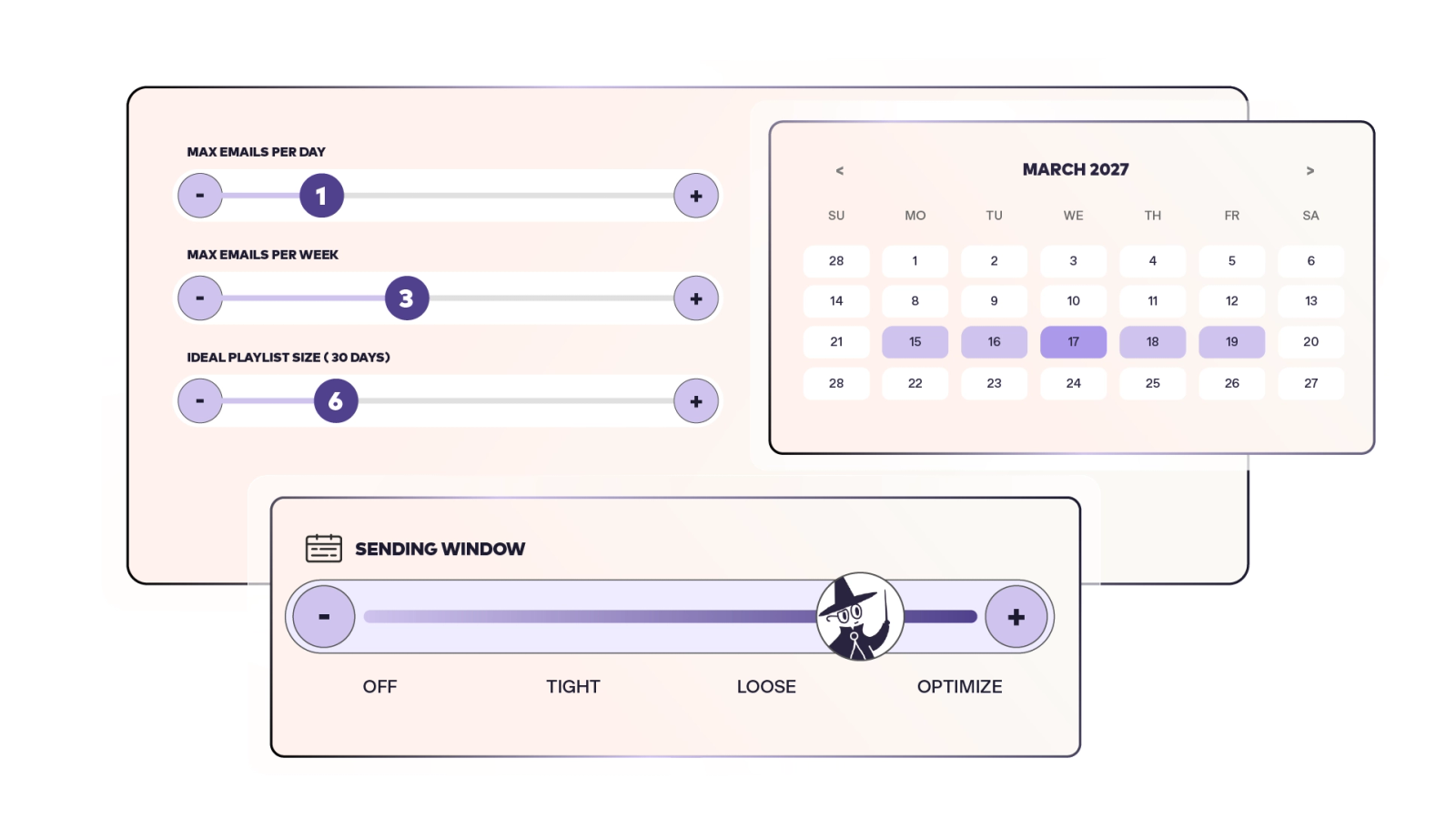
Communication limits already exist in legacy platforms, and they do stop people from being buried. What they cannot do is choose. Whichever campaign happens to mail first consumes the limit, even when it is the weaker touch. The limit protects the buyer from volume and does nothing about quality.
Because the Playlist is computed ahead, you can look at a person and see what they are scheduled to receive. No legacy platform can show you this, because nothing inside it has decided yet. It can only show you what happened last month.
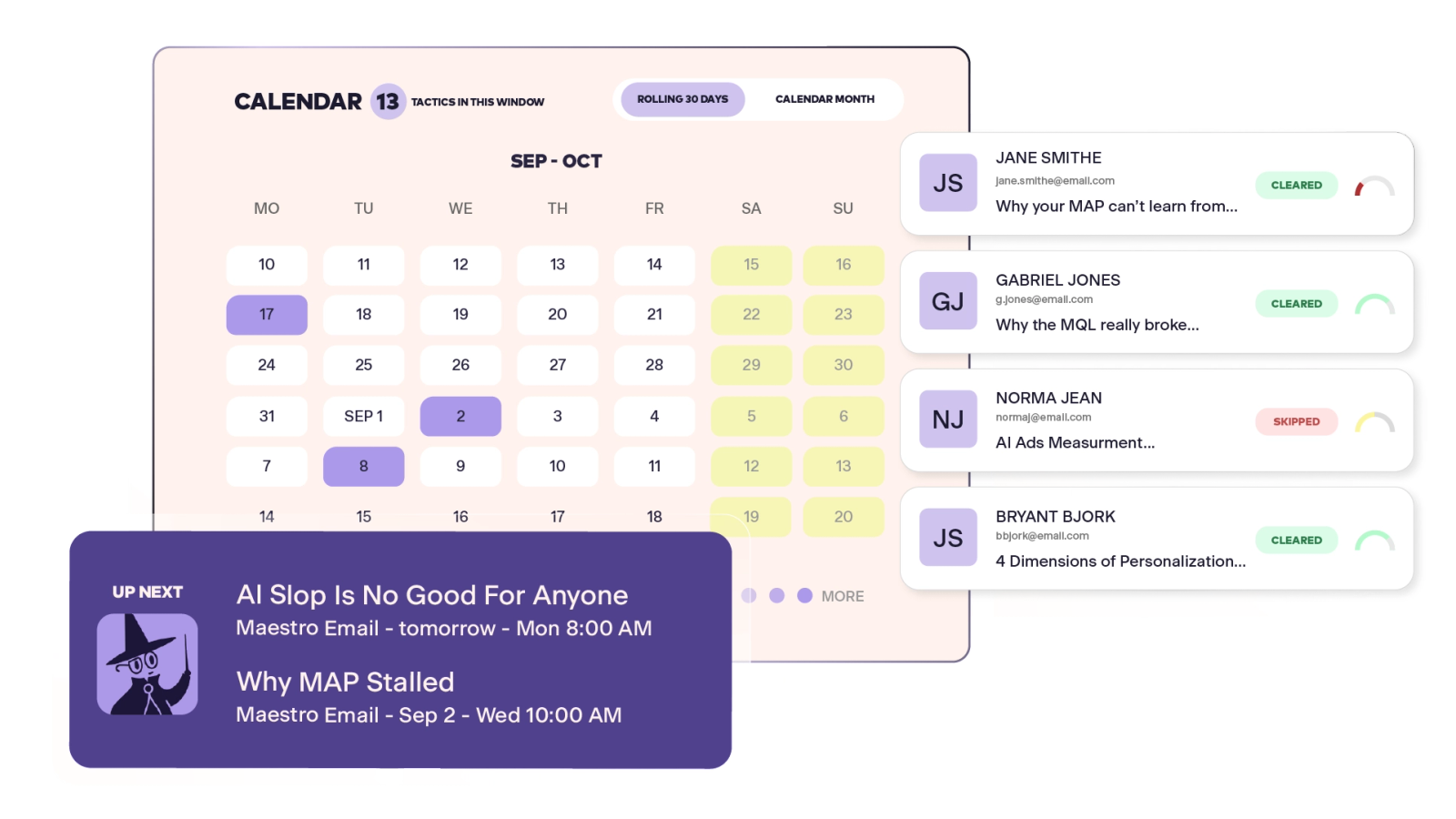
Maestro Memories are what the system has worked out about a person, an account and a buying group: what they respond to, when they open, which tactics work on them. The Playlist improves as those memories fill in. This also extends to the content itself, since the Playlist can select among approved versions of the same asset. If someone consistently responds to long, detailed copy, they receive that version, and someone who responds to short benefit-led copy receives the other. That is a description of how selection works rather than a claim about what the selection produced, and I'll write about measured results when we have held-back groups to measure against.
How much of this runs on its own is your decision, along a spectrum rather than a switch. Keep every campaign fixed with no discretion and Phave behaves like a very good marketing automation platform. Give Maestro discretion over everything and the account runs itself inside your guidelines. Most teams start near the scheduled end and move, one campaign at a time, as they see what the system does. Smart Nurture is where most of them start.
A Playlist mixes what your team already made. Campaigns are still where the thinking happens, and people still write and approve every piece of content. What changes is that a campaign becomes a candidate for a person's sequence rather than a sender in its own right.
Why B2B is different
Offer optimization is not a new idea, and in consumer marketing it worked. At Epiphany, more than twenty years ago, our Interaction Advisor product could arbitrate across dozens of offers and choose the best one in real time. Recommendation engines have been production-grade ever since, and every consumer business of any size runs one.
What made that possible is dense data. A retailer has thousands of observations per customer. One person decides. The conversion happens minutes after the offer, so the outcome teaches the model almost immediately, and it learns across millions of people at once.
B2B offers none of those conditions. A buyer might generate forty touchpoints across an eighteen-month cycle. The conversion is a committee decision months downstream from any individual email, and attributing it back to that email is guesswork. Five people at the same account behave differently, and the purchase is one event rather than five. Machine learning needs volume to find a pattern, and B2B does not produce it. That is why nobody ever solved B2B personalization with machine learning, and why the tools that did work stayed in B2C.
Reasoning changes what the data has to supply. A reasoning model does not have to derive everything from your history, because it already understands a great deal about how companies buy. It knows that a CFO on an evaluation asks about payback period while the practitioner asks whether the thing works, and that a security review arriving late is a different signal from a security review arriving early. So it can make a defensible decision about a person it has observed eight times rather than eight thousand.
That is one reason consumer offer optimizers do not transfer. Another is that nobody in B2B buys because of one email. Real-time next-best-action optimizes the current move and ignores the rest of the game, which is why it has never been much use here. You want to plan several moves ahead, the way a chess player does, and accept a touch that is not the strongest available today because of where it puts you in three weeks.
The buyer is also not a person. A B2B purchase is made by a committee, and what should reach any one member depends on what the rest of the committee has and has not seen, which roles are already engaged, and which roles have nobody in them at all. A consumer optimizer has no reason to model any of that, so none of them do. A Playlist reads the whole buying group before deciding what any individual member receives next.
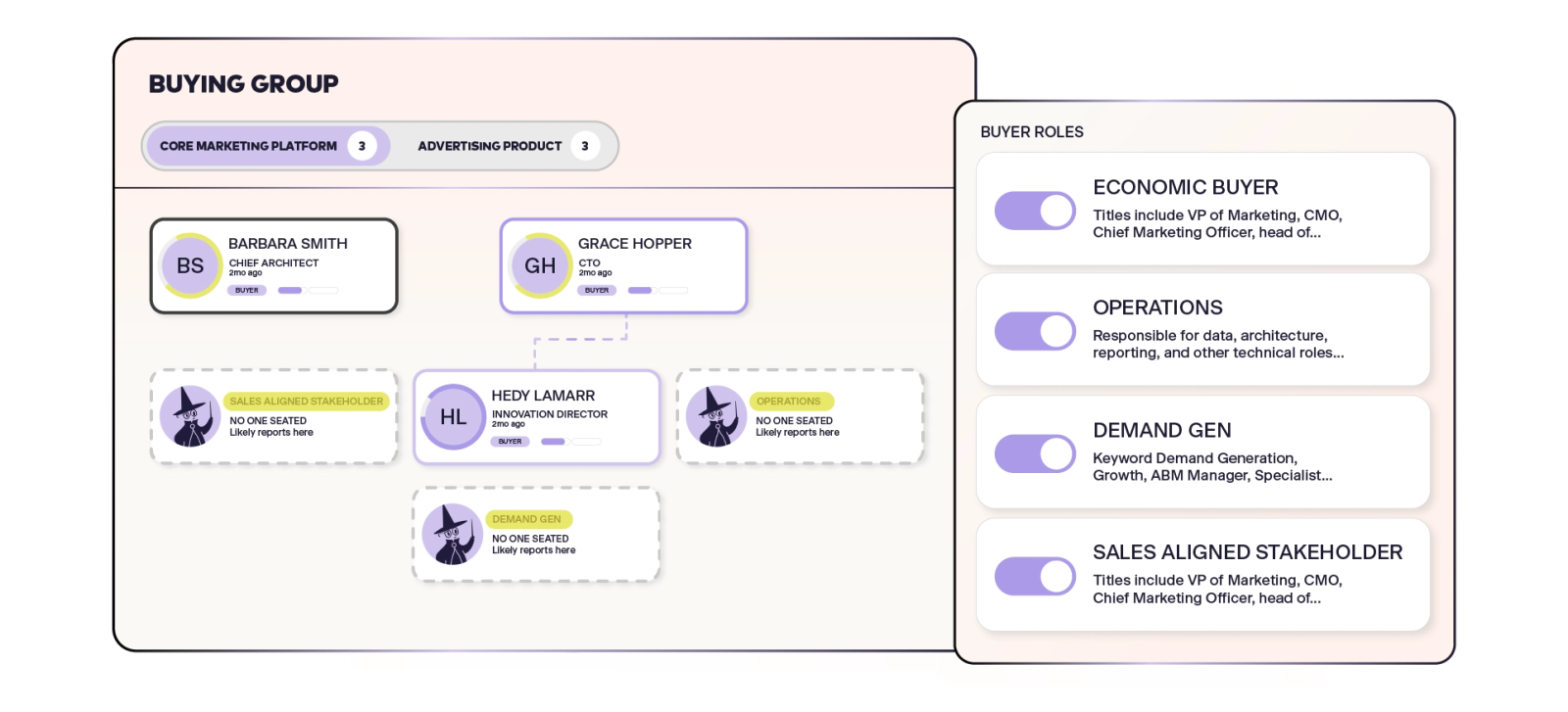
That combination is what a B2B journey optimizer has to be: a sequence rather than a next action, planned for a committee rather than a person, and reasoned rather than learned from data that was never dense enough to learn from.
What changes for the team
The sequencing work disappears. It is a larger share of a demand generation or operations week than it looks from outside.
Nobody builds the eighth track. Nobody writes the entry and exit criteria that pull a person out of the main nurture and return them afterward, or debugs it when somebody gets stuck between two of them. Nobody maintains exclusion lists so that the field event invitation does not collide with the product announcement. Nobody sits in the Monday meeting where four campaign owners negotiate over who gets to mail the enterprise segment this week. Those decisions still get made. Maestro makes them per person, for everyone, every day.
What replaces it is the work the tracks were a poor substitute for: deciding what you are optimizing toward and for whom, writing the guidance that says how to pursue it, setting the limits you want respected, and building the campaigns the Playlist draws from. That is closer to the job most people thought they were taking when they joined a marketing team.
The strategic value of the role goes up as the tactical work goes away. I've watched capable operations people spend years on configuration that was never the point of the job, and getting that time back is worth more than any single feature.
The end of the nurture track
I've spent most of my career on some version of this problem. At Epiphany it was real-time arbitration for consumer brands. At Marketo it was tokens, dynamic content and three nurture tracks. At Engagio and Demandbase it was account-based marketing, which produces genuine one-to-one work for the tier one accounts you can count on two hands and runs out of hands after that.
Every one of those got closer, and every one of them hit the same wall. When a system decides by following rules that were written in advance, it has to treat people as members of groups, because groups are the only thing a rule can address. The number of groups can grow, and the groups can get smaller, and it never becomes personalization. It becomes segmentation with more segments.
Mayer's rule has been telling us where the result comes from since the 1960s, and marketing automation spent twenty years optimizing the smallest of the three terms because it was the only one a rules engine could reach. The offer and the moment are finally decidable, one person at a time, for everyone in the database rather than for the few dozen accounts a team has the capacity to handle manually.
That is what a Playlist is for.