AI-native marketing automation
Your New Phavorite Marketing Platform
Finally. The AI-native marketing automation you've been waiting for.
See a demo






The problem with legacy marketing automation
B2B moved on.
The MAP did not.
Legacy MAPs run on rules.
Rules cannot handle judgement or ambiguity, so buyers get treated as segments instead of individuals.
Legacy MAPs focus on leads.
In B2B, a buying group at an account is what matters, before and after the sale.
Phave replaces Marketo, Pardot, Eloqua, and HubSpot with AI-native orchestration.
AI campaign orchestration, person by person
Smart, not scripted.
Every person gets their own Playlist
Not a flowchart somebody drew. The sequence most likely to reach the objective you set, ordered and timed for that one person.
Your campaigns, in the right order for each person. You make the albums. Phave makes the mix.
same campaigns, optimal order, best days
AI marketing automation without the complexity
Deep, not difficult.
Work at the speed of AI, in Phave or your own AI client
Campaigns, audiences, automations, and scoring, all written in plain language. No certification. No queue. No ticket.
Or go headless. Connect via MCP or API and run Phave from there, through the same governed operations.
Hand Maestro a brief. It builds the campaign, writes and designs the emails, wires the timing, and sets the triggers. Other AI tools fill in a template. Maestro works when your brief doesn’t match one.
Skills are how you teach Maestro, the way you’d onboard a new hire: how you build campaigns, how you segment, and how much latitude it gets. Not documents it reads. Instructions it reasons with.
You decide what Maestro does alone and what needs your approval. Every change shows exactly what it would affect before it applies.
Maestro Insights
Maestro looks at everything, every night
Your metrics, your campaigns, your results, your configuration. It highlights problems and opportunities you didn’t know about, and creates the campaigns and fixes.

“327 people don’t have enough good content to reach their optimization objective. Here are four campaigns that would fix it.”
B2B buying group marketing
Built for the new B2B playbook.
The playbook your legacy MAP was built for is over
Buying groups, anonymous research, and a lifecycle that doesn’t end at the sale — legacy MAPs weren’t built for any of it.
Buying Groups
Phave automatically maps personas and tracks each buying committee separately, so you can replace MQLs with Qualified Buying Groups (QBGs).
Full Lifecycle
Market at every stage of the journey: engagement, pipeline, opportunity, and post-sale.
Signal Aggregation
Aggregate every buying signal across people and accounts: intent data, engagement, product usage, and your own custom signals.
Migrate from Marketo, Pardot, Eloqua, or HubSpot
Nothing lost. Plenty fixed.
Everything you need. None of the workarounds.
We scored Phave and the legacy MAPs against 481 marketing automation requirements from twelve enterprise evaluations. Phave came out highest overall, and matched or beat each competitor on 90% of them.
And a long list of old problems simply stops happening.
CRM sync
Two-way and event-driven, with your API allowance checked before every call. A bulk update will not back up the queue.
Campaigns and automations
Edit a live campaign without stopping sends or double-sending. Rules fire in a defined order.
Scoring
Fit, engagement, and product interest side by side. More than one ICP, with decay and caps managed centrally.
Trusted engagement data
Bots are filtered at capture, so machine activity never reaches a score, a trigger, or your CRM.
Consent and privacy
Opt-in checkboxes, consent language, and legal footer change by location. One policy covers every market, versus a matrix maintained by hand.
Open platform
A versioned REST API, a published schema, and 300+ governed operations your own tools can call.
Migration that’s easier than you think
Forward-deployed engineers
Our consultants do it with you, every step of the way. Experts who have spent years in marketing automation.
Maestro sets you up
From an empty account to your first send, one step at a time.
A phased approach
Run Phave alongside your old platform, moving one campaign, one form, one automation at a time. Everything tested. Nothing lost.
Customer stories from B2B marketing teams migrating from legacy MAPs
Resources
All resources →Marketing Automation
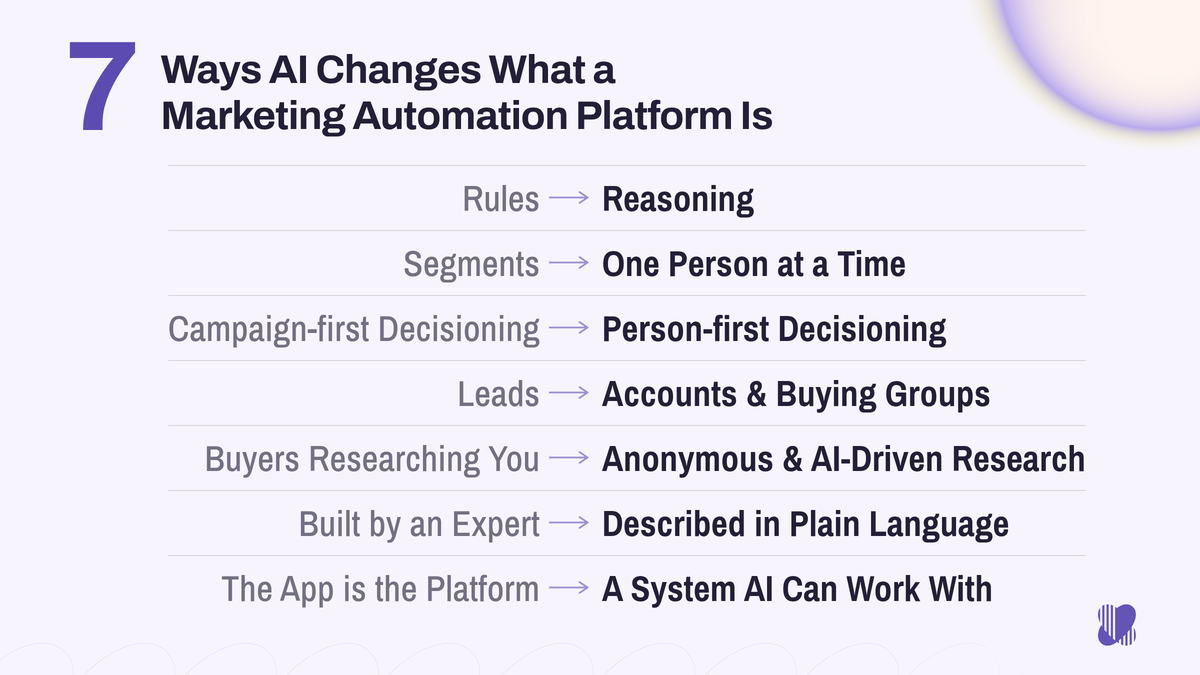
Seven Ways AI Changes What Marketing Automation Is
AI is not a feature of the next marketing automation platform. It changes what a marketing automation platform is.
Marketing Automation
B2B Personalization and the 40/40/20 Rule
Direct marketing's 40/40/20 rule says the list and the offer account for most of your result, and the creative for the rest. A Playlist starts with the person rather than the campaign, which turns the offer and the timing into decisions instead of a schedule.
Marketing Automation
What Actually Makes Marketing Automation Hard
Marketing automation made you trade power for ease because every capability had to be specified in advance by someone who knew both the platform and the company's conventions, which turned a few specialists into a queue that shaped the marketing program before anyone saw a draft. Reasoning removes the specification work, so the complexity moves to describing what you want and what good looks like.
Frequently asked questions
All questions →What is Phave?
Phave is an AI-native marketing automation platform, built to replace legacy platforms like Marketo, HubSpot, Pardot, and Eloqua. Those platforms decide by rule. Every segment, every score, and every email is something a specialist had to specify in advance.
Phave uses AI to reason instead, about every person, account, and buying group. Maestro, the intelligence inside Phave, computes a Playlist for each person: the touches most likely to reach your objective, ordered and timed for that individual, following the rules and governance you set.
You describe what you want in plain language rather than building it as configuration. Do that in Phave, in the AI your team already uses, such as Claude, ChatGPT or Gemini, or headlessly through your own code.
Phave was founded by Jon Miller, co-founder of Marketo and Engagio, and Nick Bonfiglio, formerly EVP of Global Product at Marketo.
What is AI-native marketing automation?
AI-native marketing automation is a platform where the AI makes the decisions, rather than a rules platform with AI features added to it.
Every platform has AI now. The test is whether the AI decides or only assists. Drafting a subject line, predicting a score or recommending content is assistance. Underneath, a person still drew the flowchart, wrote the rules that act on the score, and set the conditions on every branch.
Two things change with an AI-native MAP:
Deciding: audiences and segmentation, scoring, routing and persona mapping, data quality, and what each person gets and when are reasoned from evidence at the moment they are needed, including the cases nobody anticipated.
Authoring: you describe what you want in plain language instead of translating it into configuration, so work stops queuing behind whoever knows the platform.
Reasoning AI needs context. This includes how your business works: your standards, your definitions, the way your team does things, written once in plain language as skills and applied from then on. It also includes what the platform knows about each person, account, and buying group, built from how they behave over time. Without both, the reasoning produces generic output. That is the thing to test when a vendor calls itself AI-native.
AI-native marketing automation is new because the capability is. Reasoning models became reliable enough to decide only after the current generation of platforms was designed.
Phave is an AI-native marketing automation platform, built to replace a legacy MAP.
What’s the best marketing automation platform for B2B?
There is no single best marketing automation platform for B2B. The right choice depends on which constraint is binding: what your stack looks like, whether you need a website and CMS alongside marketing automation, and how much of the work you want the platform to decide rather than you specify.
HubSpot: strongest if you want website, CMS, blog, and social publishing in one system alongside marketing automation, and your team is small enough that one platform beats several.
Marketo: the default for large enterprises in the Adobe stack, with the largest partner and certification ecosystem in the category. That ecosystem is also the cost, because most teams need a certified specialist to operate it.
Salesforce Marketing Cloud Account Engagement, still widely called Pardot: the easiest to get approved if you already buy Salesforce, since it arrives on a contract and a security review your company has already done.
Oracle Eloqua: the fit for large enterprises with complex compliance and approval requirements, particularly inside the Oracle stack.
Inflection.io and Conversion.ai: newer AI-native entrants, suited to smaller B2B teams that want something newer than a legacy platform and do not need more advanced functionality.
Phave: the choice if you are replacing a legacy platform and want the AI to make the decisions, reasoning about every person, account, and buying group instead of following rules a specialist wrote in advance.
The Phave marketing automation requirements analysis scored 481 requirements drawn from twelve enterprise evaluations. Phave’s weighted score is 2.97, against 2.46 for HubSpot and 2.38 for Marketo, and Phave matches or beats every vendor evaluated on at least 90% of the requirements. Scored September 2026.
Is the MQL dead?
The MQL, or marketing qualified lead, is dead as most companies practice it. It started as a contract between marketing and sales. Marketing passed a lead only when it had strong evidence that this person was worth sales attention now, and sales committed to following up quickly. Marketing earned credibility by being selective, and sales got better conversations.
But pipeline pressure turned the scoring into a lever for volume rather than a filter for quality. Any campaign responder became an MQL. Sales cherry-picked the obvious hand-raisers, ignored the rest, and the contract broke.
Leads don’t buy B2B solutions. Companies and buying committees do. One person on a pricing page might be noise. Three people from the same account in the same week is evidence, even though no individual among them would have triggered a score.
That’s why the MQL is giving way to the Marketing Qualified Account (MQA), an account showing evidence of buying activity across more than one person, and the Qualified Buying Group (QBG), the buying committee for a specific purchase, showing evidence of active buying.
Phave co-founder Jon Miller helped popularize the MQL at Marketo and has published what should replace it. Phave maintains accounts and buying groups as real records, each carrying its own score, its own stage, and, for a buying group, which committee roles are filled and which are missing.
What is a revenue marketing platform?
A revenue marketing platform is one system for both person-based marketing automation and account-based marketing. Most B2B teams run two: a marketing automation platform for people and an ABM platform for accounts, with data moving between them. The buying group falls between the two, which is why neither system has ever owned it well.
The category is Forrester’s, formalized in a Wave published in January 2026 that evaluated ten providers. Adobe and Salesforce came to it from marketing automation, Demandbase and 6sense from account intent data and advertising, and all four were named Leaders. Vendors arriving from opposite directions is what tells you the two disciplines are merging.
To qualify, a platform needs:
Data unification across accounts, people, and buying groups.
Adaptive journeys that change with what each person does.
Account orchestration combining signals with touches.
Full lifecycle support, from anonymous through pre-sale and post-sale.
The practical question is whether you want one system for people and another for accounts, or a single system that does both. That choice decides what else you have to buy, and how much work goes into keeping two databases agreeing with each other.
Phave is a revenue marketing platform. People, accounts, and buying groups share one database, journeys adapt per person, orchestration runs on signals, and coverage runs from anonymous visitors through post-sale. Forrester published its Wave in January 2026; Phave reached general availability in August 2026 and was not evaluated.
Phave vs Marketo
Phave was founded by Jon Miller, the co-founder of Marketo, to be what comes next. Marketo is a rules-based automation system. Phave uses AI to reason about each person at the moment of decision.
Authoring: using Marketo means a specialist building things in the user interface. In Phave you describe what you want in plain language and Phave drafts it for you, following the skills and guidelines set by marketing operations.
Engagement: a Marketo engagement program is a stream, with content in a fixed order at a set cadence. Phave builds a playlist for each person, taking the full context of that person, their account, and their buying group, and crafting the sequence of actions most likely to reach the optimization objective. It recomputes as evidence changes and arbitrates across every campaign at once, so a person receives one coherent sequence without a separate manual process to keep campaigns from colliding.
Architecture: Marketo was built around people and leads, with accounts added later through a separate product. In Phave, people, accounts, and buying groups are records in their own right, each with its own score and lifecycle stage.
AI: Adobe has hosted a Marketo MCP server since May 2026, with more than 130 operations across forms, programs, smart campaigns, leads, and emails. It lets an AI assistant build Marketo’s objects faster, and the smart campaign still executes the rules it was given. It authenticates with an instance-level API credential, so the assistant acts as that service rather than as a person. In contrast, Phave registers 319 tools. Every connection acts as a named person with exactly their permissions and no more, and a send can only be approved by a signed-in human on a Phave page.
Nothing lost: across 481 requirements drawn from twelve enterprise evaluations in the marketing automation requirements analysis, Phave matches or beats Marketo on 90% of them, so a mature instance loses no critical functionality. Overall, Phave scores 2.97 against Marketo’s 2.38. Several legacy headaches are gone: duplicate sends are prevented by a database constraint rather than by careful campaign design, and CRM sync sets direction per object and per field, parks incoming changes for review, and records why any record was skipped. Source: Phave’s analysis, September 2026.
Marketo is stronger in places: twenty years of LaunchPoint integrations, deep connection to the rest of the Adobe stack, and a large pool of people who already know how to run it.
Migration takes as little as four weeks, and every customer gets a forward deployed engineer. You keep running in Marketo until you go live. Most of the time in a typical migration goes into rebuilding scoring models, nurture streams, and routing rules, and Phave needs none of them.
How much does Phave cost?
Phave starts at $36,000 a year. Pricing is based on Monthly Active Playlists: the number of people who receive something from you in a given month. Legacy platforms price on database size, so you pay for every record whether you contact it or not, which is why teams end up deleting people to stay under a cap.
Every subscription includes unlimited accounts, buying groups and opportunities, ten users, AI scoring, and a set of Maestro fields that refresh automatically. Everyone in your database gets a playlist, and Air Traffic Control resolves the conflicts across your campaigns, so nobody receives three emails on the same morning.
Additional Maestro fields, additional scoring models, and Maestro Playlists cost extra. With Maestro Playlists, Maestro fills the open gaps between your scheduled campaigns with the touches most likely to move each person, and runs the whole sequence itself where nothing is scheduled. Think of what’s included as adaptive cruise control, and Maestro Playlists as self-driving.
There is no charge for tokens and no metered AI usage. The price does not move with how much reasoning Phave does for you. You commit to a band for the year, and running consistently above it is a conversation about the right band rather than a surprise invoice.
Who founded Phave?
Phave was founded by Jon Miller and Nick Bonfiglio. Together, they helped build the marketing automation category they are now replacing.
Jon Miller co-founded Marketo and served as its CMO, where he helped define modern marketing automation and the demand generation playbook. He then founded Engagio, an account-based marketing platform, and led it as CEO until Demandbase acquired it in 2020, after which he served as Demandbase’s Chief Product Officer and CMO.
Nick Bonfiglio was EVP of Global Product at Marketo from 2009 to 2016, running engineering, operations, product, and support as the company grew from a few million in revenue to several hundred million. He went on to found Aptrinsic, now Gainsight PX, and to co-found Syncari.
They have built marketing automation software before, and they know from the inside which parts of a platform a marketing team actually depends on.
Join the Phave launch event
Martech’s Shift from Rules to Reasoning
Introducing Phave, with Jon Miller and Scott Brinker
The first public look at Phave, plus a conversation with Scott Brinker about what marketing automation becomes when it is reimagined with AI.
- Why legacy marketing automation cannot be fixed
- How AI is transforming martech
- See Phave in action
- Hear from marketers using Phave
Tuesday, September 29 · 10:00 AM PT / 1:00 PM ET
Online event

Jon Miller
Co-founder, Phave. Co-founder, Marketo.

Scott Brinker
Editor, chiefmartec. The “Godfather of Martech.”